
Starting Price (SP) Explained: When Your Odds Are Set
 Available in US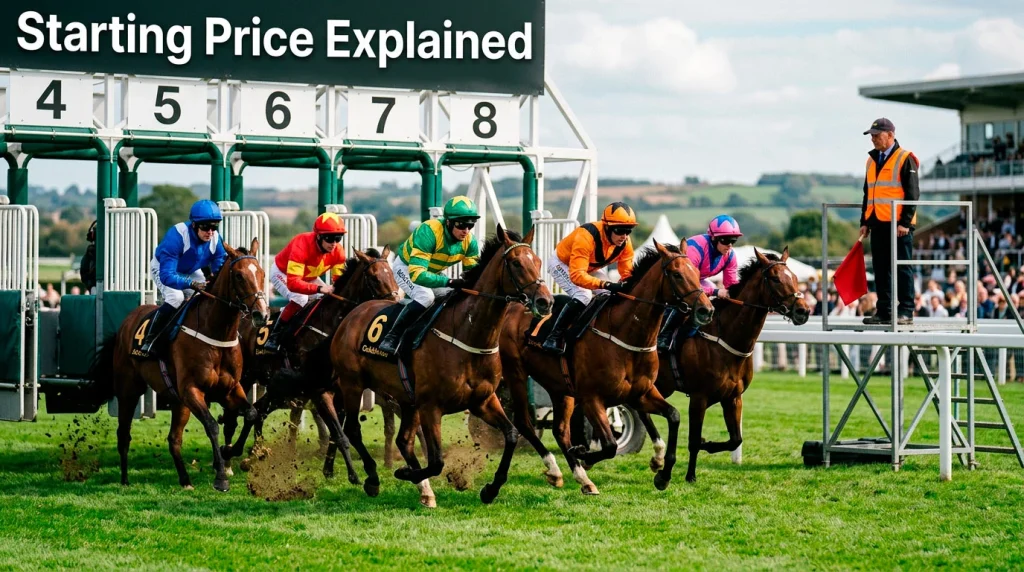
The starting price in horse racing is the official odds of a horse at the moment the race begins. It is the last price before the stalls open — the benchmark used to settle every bet placed without a specific quoted price, and the reference point against which Best Odds Guaranteed promotions are measured. If you walked into a betting shop and asked for “SP on the favourite,” you would receive whatever odds that horse was trading at when the starter called them into line.
For each-way bettors, starting price matters doubly. Both the win part and the place part of an each-way bet can settle at SP. If you did not take a fixed price, or if your bet was placed as an SP bet by default, the place payout is calculated from the starting price multiplied by the place fraction — not from any earlier number on the screen. Understanding how SP is formed, who determines it, and when it applies gives you a clearer picture of what your each-way bet will actually return.
How Starting Price Is Determined
Starting price used to be the exclusive domain of on-course SP reporters — officials who stood in the betting ring, watched the on-course bookmakers’ boards, and recorded the prevailing odds at the off. That process was manual, subjective, and depended on the liquidity of the on-course market. If only three bookmakers were trading, the SP reflected a thin sample.
Since 2026, the SP calculation has moved to a more algorithmic model that incorporates on-course market data alongside exchange prices and bookmaker pricing. The aim is to produce a figure that better reflects the true weight of money across all betting channels, not just the handful of on-course layers who happen to be standing in the ring. The Racing Post continues to publish SPs for every runner, and these remain the official settlement prices used by bookmakers across the UK.
The on-course market still matters, though. UK racecourses attracted 5.031 million visitors in 2026 — the first time attendance topped five million since 2019 — and on-course betting provides the live pricing that feeds into the SP algorithm. Without an active betting ring, the SP would lose one of its key inputs.
When SP Applies to Your Bet
SP is the default for any bet that does not specify a fixed price. In practice, that means several common scenarios. If you place a bet in a betting shop without requesting a specific price, it settles at SP. If you bet online and choose “SP” from the odds dropdown, the same applies. If you place a Tote pool bet, your payout is the pool dividend — not SP — but bookmaker-side bets without a locked price fall back to SP settlement.
Some punters choose SP deliberately, particularly when they believe the price will shorten before the off. If a horse is 10/1 in the morning and you expect heavy market support to push it to 6/1 by post time, taking SP means you accept whatever the final price is — 6/1 in this case, which is worse than the morning number. The flip side: if the horse drifts from 10/1 to 14/1 because the market identifies a concern, SP gives you 14/1 without having to monitor the market. SP is a bet on the collective judgement of the market at the moment that matters most.
SP and Each-Way Settlement
When an each-way bet settles at SP, both parts use the starting price. The win return is calculated as Stake times SP. The place return is Stake times (SP times Place Fraction) plus Stake. So if SP is 8/1 in a race with three places at one-fifth odds: win return on a £10 stake = £80 + £10 = £90; place return = £10 times (8 times 0.2) + £10 = £26.
This means the place payout on an SP bet is only confirmed once the race starts. You can estimate it from the current market price, but the actual figure depends on how the market moves in the final minutes — and late money can shift prices significantly. A horse might be 8/1 with five minutes to go and 6/1 at the off. If your bet is on SP, the place return drops from £26 to £22 without you doing anything wrong. You simply accepted the market’s final word.
SP vs Early Price: The Trade-Off
Taking an early price locks your odds in. If you back a horse at 10/1 on Monday morning and it opens at 6/1 on race day, your win return is still based on 10/1. Your place return is still 10/1 times the fraction. The market moved; your bet did not.
SP, by contrast, accepts market drift in both directions. The advantage is simplicity — you do not need to monitor prices or time your bet. The disadvantage is that you surrender the ability to capture value when prices shorten. Over a full season, systematic early-price bettors who identify value before the market corrects will typically outperform SP bettors, all else being equal. But not every punter has the time, information, or inclination to trade the morning markets, which is why SP remains a perfectly functional settlement method for the majority.
Context matters here. Total betting turnover on British racing fell 4.3% in 2026 compared to 2026, with average turnover per race down 5.6%. That decline has been driven partly by reduced liquidity in on-course markets, which in turn can make SP prices less stable. Thinner markets are more susceptible to late swings, meaning SP on a quiet Tuesday at a Core meeting may be less representative than SP at a Premier fixture with heavy on-course and exchange activity.
Best Odds Guaranteed and SP
Best Odds Guaranteed — available at most major UK bookmakers — uses SP as the comparison benchmark. If you take an early price of 8/1 and the SP turns out to be 10/1, the bookmaker pays you at 10/1. If SP is 6/1, you keep your 8/1. The principle applies to both parts of an each-way bet: your place return is also based on the better of the two prices.
BOG effectively removes the downside of taking an early price. You lock in value if the horse shortens, and you get the market price if it drifts. The catch is that not every race qualifies — most bookmakers exclude ante-post markets, certain international races, and enhanced-price promotions from BOG terms. Always check the small print before assuming your each-way bet carries the guarantee.
When SP Makes Sense
SP works best in two situations. First, when you do not have a strong view on whether the price will move — perhaps you are betting on a race where you fancy a horse on form but have no insight into market sentiment. Second, on short-priced favourites where the potential for price movement is minimal. An odds-on horse is unlikely to shift from 4/5 to 2/1; the SP will be close to whatever the market has been showing all morning.
Where SP is weakest is on longer-priced horses in volatile markets — a 20/1 outsider that could easily be 14/1 or 33/1 by the off. In those cases, taking the price when you see value gives you control. Waiting for SP is a gamble within a gamble, and not always a rewarding one.
Starting Price (SP) Explained — More on this topic at show bet payout.
See also Best Odds Guaranteed.
