
1/4 Odds vs 1/5 Odds Each-Way: Which Fraction Pays More?
 Available in US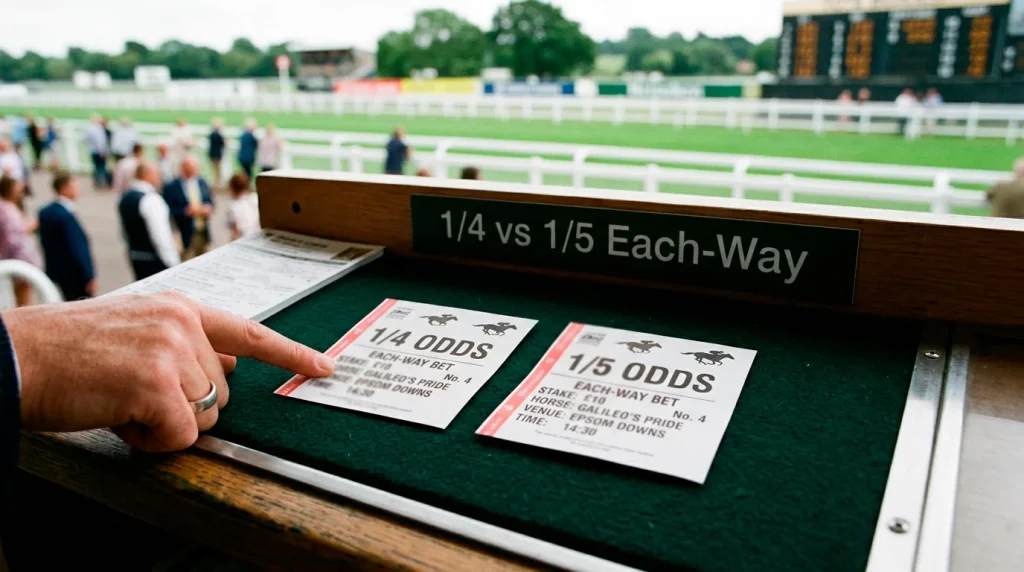
Every each-way bet in UK horse racing carries a place fraction — 1/4 odds or 1/5 odds — and the difference between them is not trivial. On a horse at 10/1, the place return at one-quarter is £35 on a £10 stake. At one-fifth, it is £30. That £5 gap may sound modest, but across a season of betting it compounds into a meaningful difference in your overall return. A fraction that makes a measurable difference deserves more than a passing glance.
Which fraction applies is not your choice. It is determined by the Tattersalls Rules on Betting, based on the number of runners and the type of race. Handicaps tend to attract the more generous one-quarter fraction; non-handicap races with larger fields settle at one-fifth. Understanding when each fraction kicks in — and how it changes your payout — is fundamental to evaluating whether an each-way bet represents value or just hope.
When Each Fraction Applies
Under Tattersalls Rules, the standard framework for each-way terms in British racing, the place fraction is tied to the field size and the race classification.
One-quarter odds (1/4) applies in two situations. First, in races with five to seven runners, where two places are paid. Second, in handicap races with twelve or more runners, where three places are paid (twelve to fifteen runners) or four places are paid (sixteen-plus). The one-quarter fraction is the more generous of the two standard settings — it returns 25% of the win odds profit on the place part of your bet.
One-fifth odds (1/5) applies to non-handicap races with eight or more runners, where three places are paid. This is the most common setting in day-to-day UK racing. In 2026, the average field size on the Flat was 8.90 runners and 7.84 over jumps, according to the BHA — meaning a significant proportion of races land in the eight-plus non-handicap bracket and settle at one-fifth terms.
The distinction matters because handicaps and non-handicaps do not just differ by fraction — they differ by the competitive dynamics that determine how likely your horse is to place. Handicap races are designed to level the field through weight allocations, which tends to produce larger, more open fields. Non-handicaps allow the best horse on ratings to carry no penalty, which can concentrate the market around a few short-priced contenders.
The Numbers Side by Side
| Win Odds | Place Return at 1/5 (£10 stake) | Place Return at 1/4 (£10 stake) | Difference |
|---|---|---|---|
| 3/1 | £16.00 | £17.50 | £1.50 |
| 5/1 | £20.00 | £22.50 | £2.50 |
| 8/1 | £26.00 | £30.00 | £4.00 |
| 10/1 | £30.00 | £35.00 | £5.00 |
| 16/1 | £42.00 | £50.00 | £8.00 |
| 25/1 | £60.00 | £72.50 | £12.50 |
The pattern is clear and consistent: one-quarter pays exactly 25% more than one-fifth at every price point. At short odds — 3/1, 5/1 — the cash difference is small enough to overlook. At longer odds, where each-way betting becomes most interesting, the gap widens substantially. A 25/1 shot that places returns £12.50 more per £10 staked under one-quarter terms. Over ten such bets in a season, that is £125 of additional return from the fraction alone.
Why the Fraction Varies
The Tattersalls framework is not arbitrary. The fractions reflect a rough balance between the number of paid positions and the generosity of each payout. When only two places are paid (five to seven runners), the one-quarter fraction compensates for the tighter qualifying criteria — your horse must finish in the top two, which is harder than finishing in the top three or four. When three places are paid in a non-handicap (eight-plus runners), the one-fifth fraction is thinner because an additional qualifying position has been added.
Handicap races break this pattern. At twelve-plus runners, three places are paid at one-quarter rather than one-fifth. At sixteen-plus, four places at one-quarter. The higher fraction recognises that handicap races are structurally more competitive — the handicapper has assigned weights to equalise chances, so the probability of any given horse placing is more evenly distributed across the field. In exchange for this greater uncertainty, the fraction stays at the more generous level.
The Strategic Implication
For the each-way bettor, the fraction creates a clear incentive to focus on handicap races. The maths is straightforward: one-quarter terms on a handicap with twelve or more runners gives you both a higher fraction and (in the sixteen-plus bracket) an extra qualifying place compared to a non-handicap of similar size. The place part of your each-way bet is measurably more valuable in a handicap.
This does not mean you should bet exclusively on handicaps — the competitive nature of those races means picking the right horse is harder, and the larger fields mean longer average odds and lower individual strike rates. But it does mean that when you are evaluating an each-way bet, the fraction should be one of the first things you check. A horse at 10/1 in a twelve-runner handicap (three places, 1/4) gives a place return of £35 on £10. The same horse at 10/1 in a ten-runner non-handicap (three places, 1/5) returns £30. The horse has not changed; the race type has.
Premier meetings tend to produce the largest handicap fields. BHA data for 2026 shows average field sizes of 11.02 on the Flat and 9.41 over jumps at Premier fixtures, compared to 8.65 and 7.63 at Core meetings. Cheltenham Festival, Ascot’s Heritage Handicaps, and the Grand National card are the obvious hunting grounds for one-quarter terms at their most generous — four places in fields that regularly exceed twenty runners. A punter who systematically targets these fixtures for each-way activity is not just chasing excitement; they are selecting the place fraction that delivers 25% more return on every qualifying finish.
Edge Cases to Watch
Non-runners can shift the fraction after you have placed your bet. If a handicap field drops from twelve to eleven runners between declaration and the off, the terms change from three places at one-quarter to three places at one-fifth. That single withdrawal costs you the higher fraction on every possible place finish. Monitoring late non-runners — particularly in races that sit close to a threshold — is essential if you want the fraction you planned for.
Enhanced place terms from bookmakers can also override the standard fraction. A bookmaker offering seven places on the Grand National might reduce the fraction to one-fifth or even lower to offset the additional positions. The headline — more places — looks attractive, but the reduced fraction means each place pays less. Whether the trade-off is worthwhile depends on the specific numbers, and the only way to know is to run the calculation at both the standard and enhanced terms before deciding which offer to take.
The fraction is a small number — a quarter versus a fifth — but it drives a 25% difference in every place payout you collect. Over the course of a year’s betting, that is a lever worth understanding and, where possible, deliberately seeking out.
1/4 Odds vs 1/5 Odds Each-Way — More on this topic at show bet payout.
See also Grand National Each-Way Betting.
