
Royal Ascot Betting Guide: Place Payouts and World Pool Data
 Available in US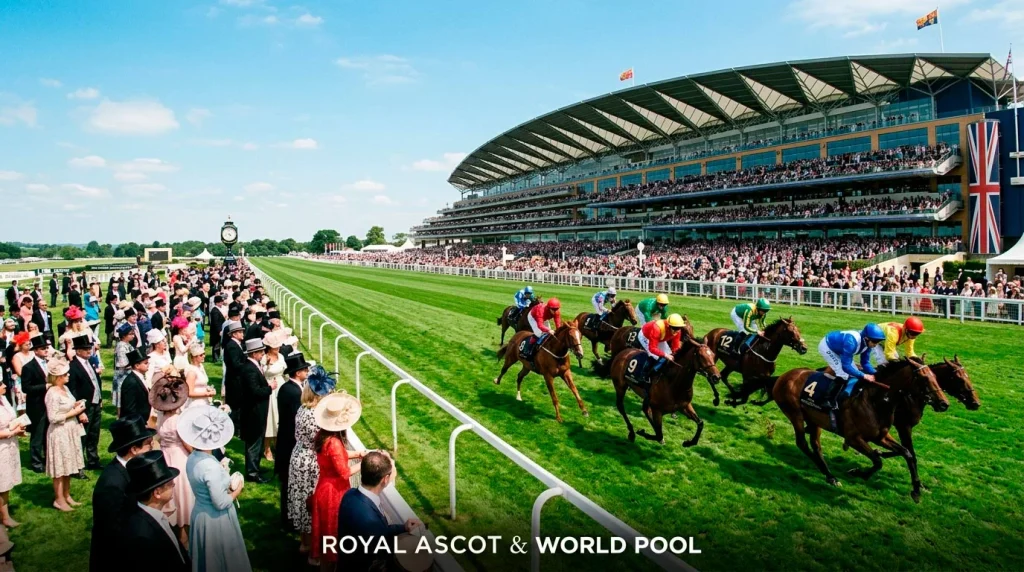
Royal Ascot is where global money reshapes your place bet payout. At most UK meetings, your each-way bet settles against bookmaker fixed odds or the domestic Tote pool. At Royal Ascot, there is a third option: the World Pool, operated by the Hong Kong Jockey Club, which merges betting liquidity from dozens of countries into a single international pool. The result is a market where dividends frequently diverge from starting price — sometimes in the punter’s favour, sometimes not.
The numbers from Royal Ascot 2026 made the case plainly. World Pool Win dividends beat the SP in 20 out of 35 races across the five-day meeting. Total World Pool turnover rose 10% year on year, reaching HK$1,574 million — approximately £150 million — over the week. For anyone betting on place outcomes at Ascot, those figures raise a practical question: when should you use the pool, when should you stick with fixed odds, and how do you tell the difference in advance?
World Pool at Royal Ascot
The World Pool connects bettors in Hong Kong, the UK, and a growing number of international jurisdictions into shared win, place, and exotic pools on selected UK races. Royal Ascot is the flagship meeting for the product. The five-day fixture attracts the largest international audience of any British Flat meeting, and the World Pool capitalises on that attention by offering pool sizes that domestic-only Tote pools cannot match.
Alex Frost, Chief Executive of the UK Tote Group, described the 2026 Royal Ascot as absolutely exceptional, noting that the World Pool perfectly showcases the enduring appeal of Britain’s highest-profile Flat meeting, particularly with an international audience. That appeal translates directly into pool liquidity: the deeper the pool, the more stable the dividends, and the less susceptible the payout to being distorted by a single large wager.
For the place bettor, World Pool liquidity matters because place pool dividends at Ascot reflect global betting patterns, not just UK market sentiment. A horse that is heavily backed in Hong Kong but overlooked in Britain may offer a thin place dividend through the pool — yet the same horse might trade at generous fixed odds with UK bookmakers who are pricing off domestic demand. The reverse also happens: a UK market mover that is unknown in Asia can deliver a large pool dividend while the bookmaker odds shorten.
Dividend vs SP: What the Data Shows
The headline statistic from 2026 is that World Pool Win dividends exceeded SP in 20 of 35 races — a 57% overpay rate. On the Exacta (forecasting the first two home), the World Pool beat the domestic Forecast in 23 of 35 races. These figures do not guarantee that the pool will pay more in any individual race, but they establish a clear pattern: at Royal Ascot, the World Pool more often outperforms SP than underperforms it.
Place pool dividends are harder to compare directly because the domestic Tote place pool and the World Pool place pool operate in parallel, and not every punter is choosing between them consciously. But the principle holds: when international money is flowing into a race, the pool size grows, and outlier dividends — both high and low — become less likely. The overall effect is a smoother dividend distribution that tends to reward bettors who pick less popular runners and penalise those who back the obvious favourite.
Place Terms at Royal Ascot
Royal Ascot is a Flat meeting, which shapes the standard place terms. The programme includes both handicap and non-handicap races, and the distinction matters for each-way bettors.
The Heritage Handicaps — the Wokingham, the Royal Hunt Cup, the Buckingham Palace — regularly attract fields of twenty to thirty runners. Under Tattersalls Rules, these settle at four places, one-quarter odds. These races are the core of the each-way betting market at Ascot: big fields, open form, and the most generous standard terms available.
The Group races — the Gold Cup, the Queen Anne, the King’s Stand, the Coronation Stakes — typically draw eight to sixteen runners. Non-handicap rules apply: three places at one-fifth odds for races with eight or more runners. The fraction is thinner, and fewer qualifying positions are available, but the quality of the fields can make place betting viable if you identify a horse with strong form that may not have the pace or class to win but is capable of finishing in the frame.
UK racecourses attracted 5.031 million visitors in 2026, and Royal Ascot accounts for a disproportionate share of that attendance. The concentration of spectators, media attention, and on-course betting activity creates a market environment where prices move sharply in the final minutes before each race — which in turn affects the starting price that your each-way bet may settle at if you did not take an early number.
Choosing Between Pool and Fixed Odds
The decision between betting into the World Pool and taking fixed odds with a bookmaker depends on what you prioritise. Fixed odds give you certainty: you know the place return the moment you place the bet. The pool gives you exposure to potential upside — if the dividend exceeds what the fixed-odds price would have returned — but also to downside if the pool dividend falls short.
A practical rule of thumb at Ascot: for popular fancies in Group races, fixed odds are usually the better choice. The World Pool will be heavy on these horses (Hong Kong bettors follow UK form closely for championship races), which means the pool dividend is likely to be modest. For less prominent runners in Heritage Handicaps, the pool can offer an edge because the international market may not know the horse and the domestic money alone might not fully price in its place credentials.
You can also use the World Pool place dividend as a post-race benchmark. After the meeting, check whether the pool dividends on your Ascot selections would have paid more or less than the fixed-odds return you received. Over the five days, the pattern will tell you whether your selection style favours pool or fixed-odds settlement — and that insight carries forward to future Ascot meetings and other World Pool fixtures.
Enhanced Offers at Ascot
Bookmakers run enhanced place terms on the biggest Ascot races, particularly the Heritage Handicaps. Five or six places instead of four is standard; some operators push to seven or eight on the Wokingham and the Royal Hunt Cup. As with any enhanced offer, check whether the fraction remains at one-quarter or has been reduced. Check also whether BOG applies — at Ascot, where late money can cause significant price movements, the guarantee has genuine value.
One approach worth considering at Ascot is splitting your each-way activity between fixed odds and the World Pool across different races on the same day. Use fixed odds on the Group races where you have taken an early price on a specific horse, and explore the pool on the Heritage Handicaps where international liquidity may produce dividends that exceed the bookmaker’s fixed-odds return. The five-day meeting gives you enough data points to observe the pattern in real time and adjust your strategy from Tuesday through Saturday.
The combination of World Pool liquidity, large-field handicaps, and competitive bookmaker offers makes Royal Ascot the week where place bettors have the widest range of settlement options. Using that range — comparing pool dividends, fixed odds, and enhanced terms across operators — is what separates a considered approach from a casual one.
Royal Ascot Betting Guide — More on this topic at show bet payout.
See also Handicap Race Place Terms.
