
Dead Heat Rules for Place Payouts in Horse Racing
 Available in US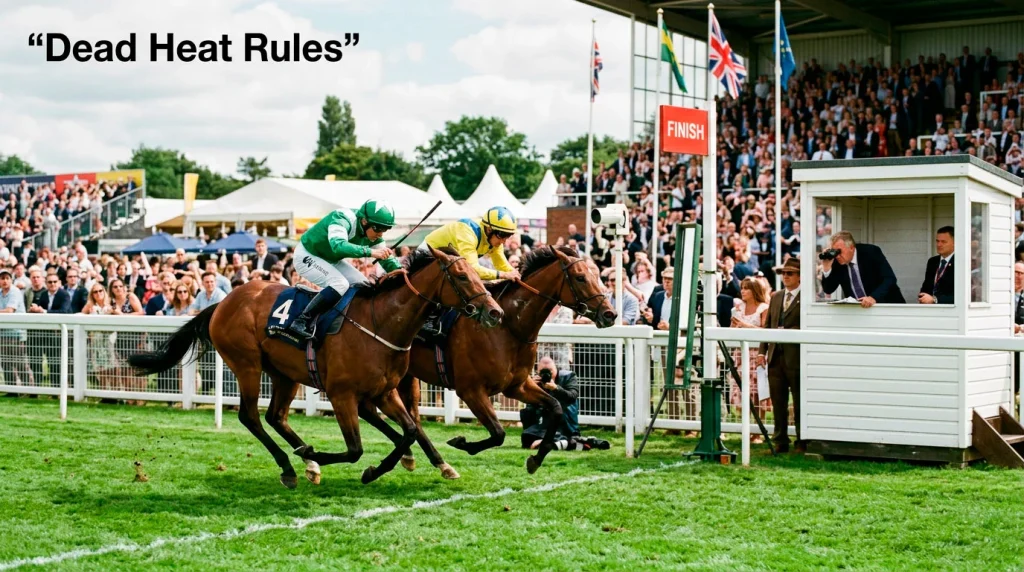
A dead heat in horse racing is rare, but when it happens on a place position, it changes your payout in ways that are not always intuitive. The basic rule — your stake is divided by the number of horses involved in the dead heat — sounds simple enough. But for each-way bettors, the critical question is where in the finishing order the dead heat occurs. When the camera cannot separate them, the maths does — and the formula differs depending on whether the tied horses are both inside the paid places or competing for the last qualifying spot.
Understanding dead heat rules for place payouts matters because the settlement is automatic. Your bookmaker applies the dead-heat reduction without consultation; you see the adjusted figure on your settled bet and either know what happened or spend twenty minutes trying to work out why the payout is lower than expected. Getting ahead of the formula means you can assess the impact before it appears on your account.
The Basic Formula
When two or more horses finish in an exact dead heat for any position, the settlement formula is: (Stake divided by N) multiplied by Odds, where N is the number of horses in the dead heat. For a £10 bet on a horse at 5/1 that dead-heats with one other horse for the win: (£10 / 2) times 5 = £25 profit, plus half the stake returned (£5) = £30 total. Without the dead heat, the return would have been £60. The dead heat halves the effective stake before the odds are applied.
The formula extends to three-way dead heats (divide by three) and beyond, though dead heats involving more than two horses are exceptionally rare. RaceTech, the technology provider for British racing, operates cameras capturing 2,000 frames per second. Even at that resolution, dead heats occur several times a year at top-level meetings — a testament to how closely matched these animals can be.
Scenario One: Dead Heat Within the Paid Places
This is the scenario that confuses the most people, because the dead heat does not reduce your payout at all. If two horses dead-heat for second place in a race paying three places, both horses finish within the paid positions. Second and third are both qualifying places. There is no dispute over who gets the place payout — both do, at full odds.
Consider a race with three paid places at one-fifth odds. You back Horse A each-way at 8/1. Horse A dead-heats for second with Horse B. Both horses finish in the paid places (positions two and three are both covered). Your place part settles at full place odds: £10 times (8 times 0.2) plus £10 = £26. No dead-heat reduction applies. The win part of your bet is lost because the horse did not win, but the place part pays in full.
The same logic applies to a dead heat for first place. If your horse dead-heats for the win, both horses occupy positions one and two. In a three-place race, both are within the places. The win part of your bet is subject to the dead-heat rule (stake halved), but the place part pays in full because both positions are inside the paid places.
Scenario Two: Dead Heat for the Last Qualifying Place
This is where the reduction hits. When two horses dead-heat for the last paid position, the dead-heat rule applies to the place part of your each-way bet.
Example: a race paying three places at one-fifth odds. Your horse finishes in a dead heat for third with one other horse. Third is the last qualifying position, and two horses are tied for it. The settlement: your place stake is divided by two before the place odds are applied. On a £10 each-way bet at 8/1: effective place stake = £5. Place return = £5 times (8 times 0.2) plus £5 = £13 instead of the £26 you would have received without the dead heat.
If three horses dead-heat for third (extremely rare but technically possible), the stake divides by three: effective stake = £3.33, and the place return drops further. The more horses involved in the dead heat for the last qualifying place, the thinner your share becomes.
The Interaction with Each-Way Bets
Each-way bets complicate dead heats because the win and place parts can be affected differently by the same finish.
If your horse dead-heats for the win in a three-place race, the win part uses the dead-heat formula (stake halved, then multiplied by win odds). The place part pays in full — both dead-heating horses are within the first three positions, so no place-part reduction applies. Your total return is: reduced win payout plus full place payout.
If your horse dead-heats for third (the last qualifying place), the win part is already lost (the horse did not win). The place part is subject to the dead-heat reduction. Your total return is: zero from the win part plus the reduced place payout. On a £20 total outlay (£10 each way), getting back £13 instead of £26 on the place part turns a marginal profit into a net loss.
A Complete Worked Example
You bet £10 each-way on a horse at 10/1 in a race paying three places at one-fifth odds. Total outlay: £20. The horse dead-heats with one other horse for third place.
Win part: the horse did not win. Win stake lost. Return: £0.
Place part: third is the last qualifying place, and two horses are tied for it. The dead-heat rule applies. Effective stake: £10 / 2 = £5. Place odds: 10 times 0.2 = 2/1. Place return: £5 times 2 plus £5 = £15.
Total return: £15. Net result: £15 minus £20 outlay = minus £5. Without the dead heat, the place return would have been £30, producing a net profit of £10. The dead heat for the last qualifying place cost you £15 on this single bet.
Now change the scenario: the same horse dead-heats for second instead of third. Second and third are both within the three paid places. No dead-heat reduction. Place return: £10 times 2 plus £10 = £30. Net result: £30 minus £20 = plus £10. The position of the dead heat — second versus third — is the entire difference between a profit and a loss.
How Often Dead Heats Happen
Dead heats are uncommon but not negligible. Photo-finish technology has made them rarer over the decades — modern cameras leave almost no margin for genuine ties — but several occur each year in British racing, typically at meetings with large fields where horses finish in bunches. Festival handicaps at Cheltenham, Ascot, and Aintree are the most likely settings for dead heats on place positions, precisely because the competitive fields and tight finishes that make those races exciting also make them harder to separate.
You cannot predict a dead heat, but you can understand the financial impact before it happens. If you back a horse each-way and it finishes in a dead heat for the last paid place, expect your place return to be halved. If the dead heat is for any position above the last qualifying spot, your payout is unaffected. The formula is consistent; the only variable is where in the order the tie falls.
Dead Heat Rules for Place Payouts in Horse Racing — More on this topic at show bet payout.
See also Tote Placepot Explained.
