
Fractional Odds vs Decimal Odds for Place Bets
 Available in US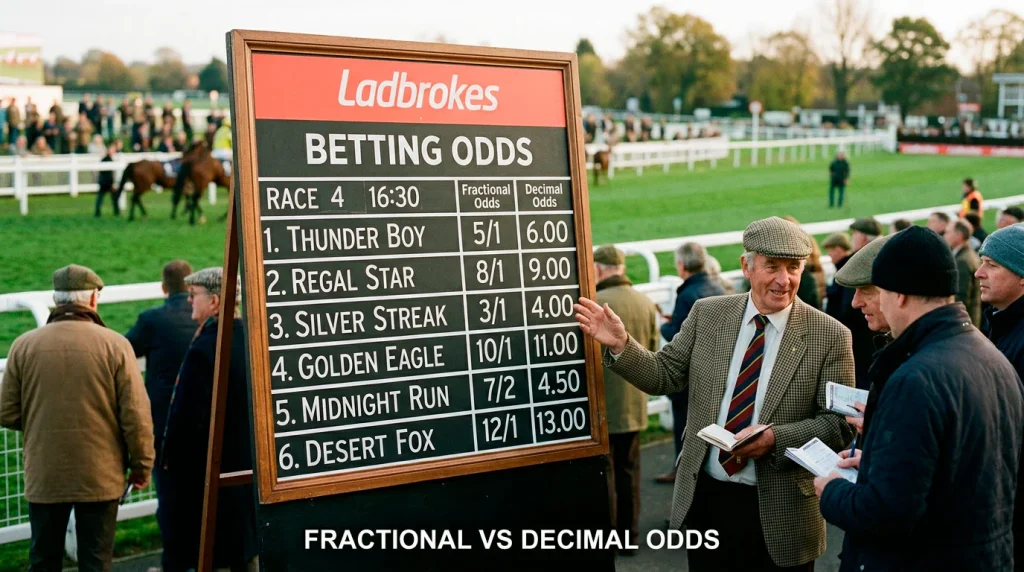
Fractional odds and decimal odds are two ways to write the same price — but when you are calculating a place bet payout, the format you start with changes the formula you need to use. Get the conversion wrong and the final number is off, sometimes by enough to make a bet look profitable when it is not.
In the UK, fractional odds remain the default on racecourse boards, in Racing Post cards, and across most high-street bookmakers. A horse is 5/1, 7/2, or 11/4. Betting exchanges, European-facing operators, and an increasing number of online sportsbooks display the same prices in decimal: 6.0, 4.5, 3.75. Both formats describe identical implied probabilities and identical payouts — they just express them differently, and place bet calculations require a slightly different route through the arithmetic depending on which one you are working with.
This guide covers the conversion formula, applies it to place payouts at both one-quarter and one-fifth terms, and flags the spots where punters most often trip up.
The Conversion Formula
Moving between formats is a single operation. To convert fractional to decimal: divide the numerator by the denominator, then add 1. So 5/1 becomes (5 / 1) + 1 = 6.0. And 7/2 becomes (7 / 2) + 1 = 4.5. The “+1” accounts for the stake return, which decimal odds include by default and fractional odds do not.
Going the other way — decimal to fractional — subtract 1, then express the result as a fraction. Decimal 3.75 becomes 3.75 minus 1 = 2.75, which is 11/4 in fractional form. Some prices convert to neat fractions; others produce awkward decimals that bookmakers round to the nearest standard fraction. A price of 4.33 in decimal is roughly 10/3, which most UK bookmakers will display as 3/1 or 7/2 depending on where their pricing sits.
Why does this matter for place bets specifically? Because the place fraction operates on the profit portion of the odds — not the full decimal figure. If you are comfortable in fractional, you apply the fraction directly to the numerator. If you think in decimal, you must strip out the stake component first. Using the wrong method is the single most common arithmetic error in each-way calculations, and it compounds when the odds are not round numbers.
Calculating Place Odds: Fractional Route
When you have fractional win odds, deriving place odds is straightforward: multiply the numerator by the place fraction. At 10/1 with one-fifth terms, the place odds are (10 times 1/5) / 1 = 2/1. At 10/1 with one-quarter terms: (10 times 1/4) / 1 = 5/2. The denominator stays the same; only the numerator shrinks.
For odds with a denominator other than 1, the same logic applies but requires an extra step. At 7/2 with one-fifth terms: numerator = 7 times 0.2 = 1.4. Place odds = 1.4/2, which simplifies to 7/10. The place return on a £10 stake: £10 times (7/10) + £10 = £17. Or just: £10 times 0.7 + £10 = £17. At 11/4 with one-quarter terms: numerator = 11 times 0.25 = 2.75. Place odds = 2.75/4. Place return on £10: £10 times (2.75/4) + £10 = £16.88. These non-round results are perfectly normal — bookmakers settle to the penny.
Calculating Place Odds: Decimal Route
With decimal odds, the formula is: Place Decimal Odds = ((Decimal Win Odds minus 1) times Place Fraction) + 1. At 6.0 decimal (which is 5/1) with one-fifth terms: ((6.0 – 1) times 0.2) + 1 = (5 times 0.2) + 1 = 2.0. Place return on £10: £10 times 2.0 = £20.
At the same 6.0 with one-quarter terms: ((6.0 – 1) times 0.25) + 1 = 1.25 + 1 = 2.25. Place return: £10 times 2.25 = £22.50. The extra 0.05 in the fraction — one-quarter versus one-fifth — translates to £2.50 more on every £10 staked. Over dozens of bets across a season, that gap accumulates.
Place Returns at a Glance
| Win Odds (fractional) | Win Odds (decimal) | Place Return at 1/5 (£10 stake) | Place Return at 1/4 (£10 stake) |
|---|---|---|---|
| 2/1 | 3.0 | £14.00 | £15.00 |
| 4/1 | 5.0 | £18.00 | £20.00 |
| 5/1 | 6.0 | £20.00 | £22.50 |
| 7/1 | 8.0 | £24.00 | £27.50 |
| 10/1 | 11.0 | £30.00 | £35.00 |
| 14/1 | 15.0 | £38.00 | £45.00 |
| 20/1 | 21.0 | £50.00 | £60.00 |
| 25/1 | 26.0 | £60.00 | £72.50 |
| 33/1 | 34.0 | £76.00 | £92.50 |
| 50/1 | 51.0 | £110.00 | £135.00 |
Two things stand out. First, the gap between one-quarter and one-fifth returns widens as the win odds increase. At 2/1 the difference is just £1; at 50/1 it is £25 on a £10 stake. Second, every figure in the table is deterministic — it can be calculated before the race, which is the defining feature of fixed-odds place betting in the UK. Under Tattersalls Rules, the fraction depends on the field size and race type: one-fifth applies to most non-handicap races with eight or more runners, while one-quarter covers handicaps with twelve-plus runners and smaller races with five to seven runners.
Common Pitfalls
The most frequent error is forgetting to subtract 1 before applying the place fraction in decimal format. If you take 6.0 and multiply by 0.2, you get 1.2 — which is the place odds without the stake return. Your calculated place return would be £12 instead of £20, an £8 shortfall. The correct step is always: subtract 1 first, apply the fraction, then add 1 back.
A subtler trap involves odds-on prices. At 4/6 fractional (1.67 decimal), the place return at one-fifth terms is: ((1.67 – 1) times 0.2) + 1 = 1.134. On a £10 stake: £11.34. You are risking £10 to make £1.34 on the place part — a thin margin that only makes sense when the probability of placing is extremely high. Many punters do not realise how slim odds-on place returns actually are until they see the numbers in front of them. The win part of the each-way carries the real payload; the place part at short prices is more insurance than income.
Finally, watch for non-standard fractions. Some bookmakers offer enhanced place terms at one-third or one-half for promotional races. These fractions do not appear in the Tattersalls standard table, and most quick-reference converters will not include them. If the bookmaker is offering one-third odds on a 12/1 shot, your place odds are 4/1, not the 12/5 you would get at one-fifth. That is a materially different bet, and entering the standard fraction into a calculator will give you the wrong answer.
The average UK Flat race in 2026 had 8.90 runners, meaning three-place terms at one-fifth odds were the most common setting. Over jumps, the average was 7.84 — still in the three-place range but closer to the threshold where one runner fewer could drop the terms to two places. Knowing where the field size typically lands helps you anticipate which fraction will apply, which in turn determines whether the fractional or decimal route through the maths gets you to the right answer fastest.
Fractional Odds vs Decimal Odds for Place Bets — More on this topic at show bet payout.
See also Starting Price (SP) Explained.
