
Horse Racing Form Guide: How to Pick Place Contenders
 Available in US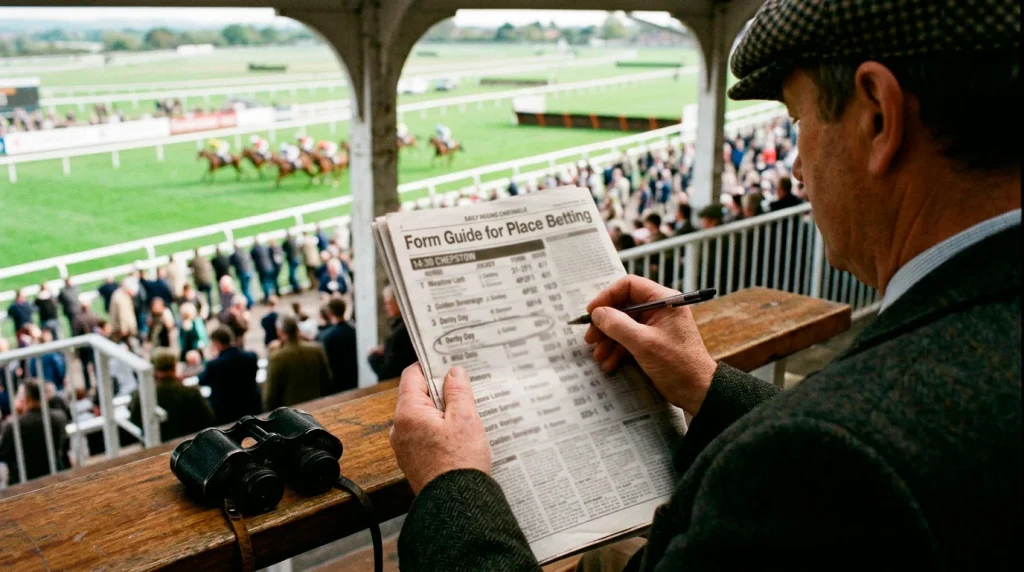
A horse racing form guide is the primary tool for evaluating whether a horse will finish in the places — and reading form for place finishes is a different discipline from reading form for winners. A horse that never quite wins but consistently finishes second or third at competitive odds is a poor selection for a win bet and an excellent one for an each-way place bet. The signals are in the form book; the skill is knowing which ones to prioritise when your objective is a place finish rather than a victory.
UK racecourses attracted 5.031 million visitors in 2026, and the BHA estimates that 68% of racegoers were casual or first-time visitors. Many of them will have placed an each-way bet based on little more than a name or a tip. This guide is for anyone who wants to take the next step — using form data to identify horses with genuine place potential, even when they are not short enough in the market to attract the win-only crowd.
Reading the Form Line
Every horse’s recent form is expressed as a string of numbers and letters. A sequence like 2312 means the horse finished second, third, first, and second in its last four runs, reading right to left (most recent run last). Letters carry specific meanings: F for fell, P for pulled up, U for unseated rider, 0 for finished outside the first nine.
For place-betting purposes, the numbers that matter are not just 1s. A form line of 23432 tells you the horse has finished in the places in four of its last five runs without winning any of them. That is a place machine — a horse that consistently competes at its level without having the turn of foot or the weight of class to cross the line first. These are the horses that win you money on the place part of each-way bets while most of the market ignores them in favour of the fancied runners at the top of the card.
Place-Specific Signals
Look beyond the finishing position to the margin of defeat. A horse that finishes fourth, beaten a length, was closer to third place than a horse that finishes second, beaten twelve lengths. Beaten distances reveal how competitive the finish was — and for place betting, a tight fourth in a strong race can be more informative than a distant second in a weak one.
Frequency of places matters more than any single run. A horse that has placed in five of its last eight starts has a demonstrated place strike rate of 62.5%. Even if none of those were wins, the consistency indicates a reliable each-way proposition. Compare that with a horse that has won twice in eight starts but finished unplaced in the other six — a 25% place rate that is less dependable for the place-betting punter.
Weight of competition is the third signal. A horse placing repeatedly in Class 2 handicaps has proven it belongs in those fields. If it drops to a Class 3, it should be more competitive; if it rises to a Class 1, it may struggle. For place betting, the class of race relative to the horse’s usual level is a critical filter. Horses running at or slightly below their proven class are more likely to place than those stretching above it.
Going Preference
The ground conditions — known as “the going” — affect every horse differently. Some horses are specialists on soft ground; others need it firm to show their best. The form book records the going for each previous run, and patterns emerge quickly. A horse with form figures of 1223 on good-to-soft ground and 0870 on firm ground is a place contender when the forecast calls for rain and a liability when the sun is out.
For place bettors, going preference is particularly relevant because it affects consistency. A horse that handles a range of ground conditions is more reliably placed across different meetings and seasons than one with a narrow going preference. If you are building an each-way portfolio across a Saturday card, horses with form on the prevailing ground — or on a range that includes it — are safer selections than those with unanswered going questions.
Distance and Stamina
Stamina is the place bettor’s ally. Horses running over distances at the upper end of their range tend to stay on in the closing stages — they may not quicken to win, but they rarely stop. A horse proven at two miles but stepping up to two-and-a-half miles might not win, but its stamina could carry it into the places while speedier rivals fade.
The form book shows each horse’s record at different distances. Look for horses that have placed repeatedly at today’s distance or further. A horse with three place finishes at a mile and six furlongs running at the same trip is a reliable frame contender. A horse dropping back from two miles to a mile and two furlongs might lack the pace to compete for a place against specialists at the shorter distance.
Trainer and Jockey Statistics
Trainer strike rates for places versus wins reveal patterns that the betting market does not always fully price in. A trainer with a 12% win strike rate but a 40% place strike rate is producing consistent frame runners — horses that fill the minor positions without regularly threatening to win. These runners are frequently overlooked by the win-focused market but represent the backbone of each-way profitability.
Jockey-trainer combinations are equally worth tracking. Certain jockeys ride for place money more effectively than others — giving beaten horses every chance to hold their position in the closing stages rather than asking one-dimensional questions at the front. A jockey who regularly delivers place finishes for a particular trainer is a data point worth noting, even if neither name is in the headlines.
Course Form
Course specialists exist. Some horses run markedly better at specific tracks — the contours, the ground drainage, the run-in length all contribute. A horse that has placed in three of four visits to Cheltenham is a stronger each-way bet at Cheltenham than a horse with superior overall form but no experience at the track.
Course-and-distance form is the gold standard: a horse that has placed at today’s track over today’s trip has answered both questions simultaneously. It handles the course and it stays the distance. These horses do not always start at short prices, particularly if they have not won — but their place records at the specific venue make them each-way selections with form-based conviction rather than guesswork.
None of these factors works in isolation. The best each-way selections tick multiple boxes: consistent form, proven on the going, comfortable at the distance, trained by a yard with a strong place record, and experienced at the course. When the form evidence aligns across several dimensions, the horse is not just a speculative place bet — it is a considered one, backed by the data that the form book provides to anyone willing to read it carefully.
Horse Racing Form Guide — More on this topic at show bet payout.
See also Field Size and Place Betting.
