
What Is a Show Bet in Horse Racing?
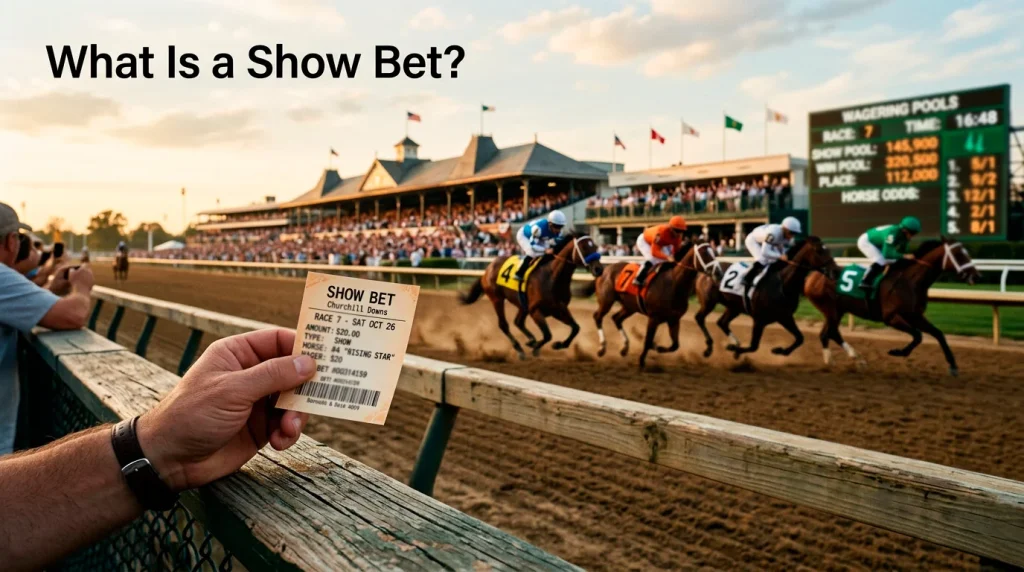
If you have ever searched for what is a show bet while browsing UK racing sites, you probably noticed something odd: nobody seems to use the term. That is because “show bet” belongs to the American pari-mutuel system, where it means backing a horse to finish in the top three. Walk into any British bookmaker — online or on the high street — and you will not find a button labelled “show.” Instead, the function is covered by the place part of an each-way bet, though the two are not interchangeable once you look under the bonnet.
The distinction matters more than terminology. In the United States, a show bet is settled through a pool: every dollar wagered on show goes into one pot, the track takes its commission, and the remainder is divided among winning ticket holders. In the UK, a place bet is settled at fixed odds derived from the win price and a place fraction set by Tattersalls Rules. One system gives you a known return the moment you click “place bet”; the other leaves the final payout open until every last punter has had their say. Understanding which system applies — and why — is the first step toward knowing what your money is actually doing once the stalls open.
Britain’s racing economy is not a niche curiosity, either. The industry contributes an estimated £4.1 billion to the national economy each year and supports roughly 85,000 jobs, from licensed training yards to racecourse hospitality. Meanwhile, the UK Gambling Commission’s 2026 survey found that 10.3% of adults bet on horse racing or other sports online. When that many people are placing bets in a market of this size, knowing the precise mechanics behind a payout is not academic — it is practical.
The Show Bet in American Racing
On any US racetrack — from Churchill Downs to Santa Anita — the betting menu starts with three options: win, place, and show. A show bet is the simplest of the three. You are wagering that your horse will finish first, second, or third. It does not matter which of those positions it lands in; as long as it crosses the line in the top three, you collect.
The payout is determined entirely by the pari-mutuel pool. Every show wager feeds into a single pot. After the race, the track deducts its takeout — typically between 15% and 25%, depending on the state — and the remaining money is split among holders of winning tickets. If you backed a heavy favourite that half the crowd also backed, your share of the pool is small. If you picked a longshot that few others fancied, the pool rewards you more generously. The odds are not fixed in advance; they crystallise only when betting closes.
This is why show bets on favourites sometimes return barely more than the stake. A $2 show bet on a 1/2 shot in a small field might pay $2.20 — a five percent return that feels more like a rounding error than a wager. The minimum payout at most US tracks is $2.10 on a $2 ticket, meaning the floor is just five percent above your money back. Yet show bets remain popular precisely because they offer the highest strike rate of the three pool wagers. The price of safety is a thinner dividend.
Where the Term Applies — and Where It Does Not
Show betting is standard vocabulary across North American tracks and in any jurisdiction that runs a pari-mutuel system modelled on the US template. Hong Kong uses a similar structure under the label “place” (confusingly, in HK “place” means top three, not top two as in America). Australia offers “show” equivalents through its tote pools, though local terminology varies by state.
In Britain, the word “show” simply never entered the racing lexicon. The reason is structural: UK betting developed around bookmakers offering fixed odds, not around track-operated pools. When a British punter wants to back a horse for a place finish, the bet is built into the each-way format or placed as a standalone Tote pool bet. Both routes exist, but neither is called a show bet, and neither works quite the same way as the American version.
Why the UK Has No Show Bet
Three features of British racing make a direct transplant of the show bet impossible. First, the UK runs on fixed odds for most bets. When you take 8/1 each-way with a bookmaker, the place part pays a fraction of those fixed odds — typically one-fifth or one-quarter — and that fraction is locked in at the moment of the bet (or at starting price if you do not take a price). There is no pool to divide.
Second, the number of places paid in the UK is not fixed at three. Under Tattersalls Rules, the standard framework that governs each-way terms, the places paid depend on how many runners line up. In a five-to-seven runner race, only two places are paid. In an eight-plus non-handicap, three places. In a sixteen-plus handicap, four. So while a US show bet always means top three, a UK place bet might mean top two, top three, or top four depending on the race conditions. The goalposts move with the field size.
Third, the Tote — Britain’s pool betting operator — does offer pool-based place bets, but these are a minority of the market. The vast majority of UK horse racing wagers are placed with licensed bookmakers at fixed odds. Even when a punter uses the Tote, the product is branded as a “place” pool, not a “show” pool. The terminology barrier is complete.
The UK Equivalent: The Place Part of an Each-Way Bet
The closest thing to a show bet in British racing is the place element of an each-way wager. An each-way bet is two bets in one: a win bet and a place bet, each for the same stake. If you put £10 each-way, you are spending £20 — £10 on your horse to win and £10 on it to finish in the places. If the horse wins, both parts pay. If it finishes second or third (or fourth in a big handicap), only the place part pays. If it finishes outside the places, both parts lose.
The place payout is calculated as: Stake multiplied by (Win Odds times Place Fraction), plus stake returned. So a £10 each-way bet on a horse at 10/1 in a race paying three places at one-fifth odds would return £10 times (10 times 0.2) plus £10 = £30 on the place part alone. Add the win part if the horse actually wins, and the total climbs higher. The maths is transparent and calculable before the race — a fundamental contrast with the pari-mutuel approach, where you are guessing your return until the pool closes.
That transparency comes with a trade-off. In a pool system, an unpopular horse that sneaks into third can deliver a surprisingly large show payout because so few people backed it. In the UK fixed-odds system, the place payout is locked to the win price. A 50/1 outsider that places will always pay a set fraction of 50/1, regardless of how many or how few punters backed it. The upside is predictability; the downside is that you miss the occasional windfall that pool betting produces when the crowd gets it wrong.
When a UK Punter Might Search for “Show Bet”
Most UK searches for “show bet” come from one of two groups: American bettors trying to understand British racing, or British punters who have encountered the term on a US-facing site and want to know how it translates. In both cases, the answer is the same — look at the place part of an each-way bet, but do not assume the mechanics are identical.
The key differences to keep in mind: a show bet always covers the top three and is settled by the pool; a UK place bet covers a variable number of positions and is settled at fixed odds (unless you are betting into the Tote). The cost structure differs too. A US show bet is a single wager. A UK each-way bet is two wagers, doubling the outlay. You can place a standalone Tote place bet in the UK without the win component, but you cannot do that with a traditional bookmaker each-way bet — it is both parts or nothing.
For anyone moving between the two markets, the practical advice is straightforward: check the place terms before you bet in the UK, because the number of paid places is not a given. And if you are used to US show payouts, remember that the British system will give you a fixed return rather than a share of whatever the crowd left in the pool. Same sport, different architecture — and a bet that your horse finishes in the top three means something slightly different on each side of the Atlantic.