
How Show Bet Payouts Are Calculated in Pari-Mutuel Racing
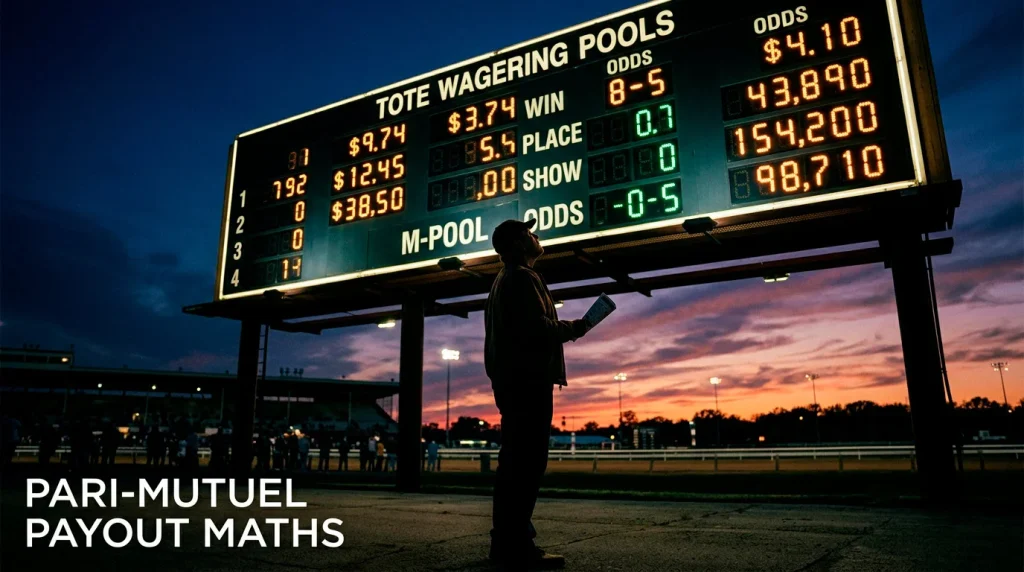
A show bet payout in horse racing is not set by a bookmaker. There is no price on a board, no fraction of win odds, no number locked in when you hand over your money. In the American pari-mutuel system, the show payout is determined by the pool — the total sum wagered on show bets for that race — and it is not finalised until betting closes and the horses cross the line.
For anyone used to UK fixed-odds betting, where the place part of an each-way returns a calculable fraction of the quoted price, pari-mutuel maths can feel opaque. The pool divides the money after the track takes its cut, and your share depends not just on whether your horse finishes in the top three, but on how many other people backed the same outcome. This article walks through each step of that calculation — from the raw pool total to the final number printed on your ticket — so that the mechanics are clear before you place a single dollar.
Understanding the pari-mutuel show formula also puts the UK system in sharper context. British horse racing generates £766.7 million in gross gambling yield from remote betting alone, according to the UK Gambling Commission’s 2026-2026 data. Almost all of that flows through fixed-odds bookmakers. But the UK does have its own pool operator — Britbet handles on-course Tote pools worth over £73.6 million annually — and grasping pari-mutuel logic helps make sense of Tote dividends and World Pool returns on British racecourses too.
Step One: The Show Pool Forms
Every show wager placed on a race — whether at the window, through a self-service terminal, or via an advance-deposit wagering account — feeds into a single show pool. If 3,000 people each bet $2 on show across a ten-horse field, the show pool totals $6,000 before the race even starts. Late money keeps arriving until gates open, meaning the pool size is not confirmed until the off.
Each horse within the pool has its own sub-total. If Horse A attracted $1,200 in show bets, Horse B drew $800, and Horse C pulled $400, those figures become critical once the race is over. The pool does not care about the horse’s morning-line odds or its form — only about how much money sits behind each runner.
Step Two: Takeout
Before any payouts are calculated, the track deducts its commission. This is called the takeout, and it typically ranges from 15% to 25% of the total pool, depending on the state’s racing commission and the wager type. Show pools tend to carry a lower takeout than exotic bets like trifectas, but the exact percentage varies.
On a $50,000 show pool with a 20% takeout, the track removes $10,000. The remaining $40,000 is the net pool — the money available for distribution to winning ticket holders. That $10,000 does not vanish; it funds purses, track maintenance, state taxes, and the operational costs of running live racing. The takeout is the house edge of pari-mutuel betting, and unlike a bookmaker’s overround, it is applied transparently and uniformly.
Step Three: Dividing the Net Pool
Here is where the maths gets specific. The net pool is divided among the three finishing positions — first, second, and third — in equal shares. On our $40,000 net pool, each position receives a $13,333.33 share (before the next step).
From each positional share, the track subtracts the total amount wagered on show for that particular horse. The result is the profit pool for that horse. Suppose Horse A (the winner) had $5,000 wagered on it for show. The profit pool for Horse A is $13,333.33 minus $5,000 = $8,333.33. That profit pool is then divided by the total show handle on Horse A ($5,000) to produce the profit per dollar: $8,333.33 / $5,000 = $1.67 per $1 wagered. Add the original $1 stake back, and the gross return is $2.67 per $1, or $5.34 on a standard $2 show ticket.
The same calculation runs independently for Horse B (second) and Horse C (third). Each may produce a different per-dollar profit because each had a different amount of money behind it. A lightly backed horse that finishes third can easily return more per dollar than a heavily backed winner, because fewer bettors are splitting that horse’s share of the pool.
Breakage: Rounding Down
Pari-mutuel payouts are not reported to the penny. US tracks round down to the nearest dime (ten cents) or, in some states, the nearest twenty-cent increment. This rounding is called breakage, and the leftover cents stay with the track or flow into a state fund.
On that $5.34 payout, breakage at the dime level would reduce it to $5.30. The four cents per ticket is trivial in isolation, but across thousands of tickets and thousands of races, breakage adds up to meaningful revenue for the racing operation. From the bettor’s perspective, breakage is a minor and largely invisible cost — but it does mean that the theoretical payout is always slightly higher than what you actually receive.
Minimum Payouts and Minus Pools
Nearly every US jurisdiction mandates a minimum show payout: $2.10 on a $2 bet, which represents a five-percent return on top of the stake. This floor exists to prevent a situation where a punter gets back less than the ticket price — something that could theoretically happen if an overwhelming favourite attracted the vast majority of show money.
When the natural pool maths would produce a payout below $2.10, the track is forced to cover the difference out of its own funds. This is called a minus pool, and it is the racetrack equivalent of a bad trade. Minus pools most commonly occur in short-priced fields where one horse is so dominant that nearly everyone bets it for show. The track absorbs the loss, which is one reason heavily odds-on favourites are not popular with operators.
A Worked Example: $50,000 Pool, Three Finishers
To tie it all together, consider a race with a $50,000 show pool and a 20% takeout. Net pool: $40,000. Three horses finish in the money:
| Position | Horse | Show Handle |
|---|---|---|
| 1st | Thunder Road | $12,000 |
| 2nd | Blue Sovereign | $6,000 |
| 3rd | Dark Prairie | $2,500 |
Each positional share of the net pool: $40,000 / 3 = $13,333.33.
Thunder Road (1st): profit pool = $13,333.33 – $12,000 = $1,333.33. Profit per $1 = $1,333.33 / $12,000 = $0.11. Gross return per $1 = $1.11. On a $2 ticket: $2.22, rounded down to $2.20.
Blue Sovereign (2nd): profit pool = $13,333.33 – $6,000 = $7,333.33. Profit per $1 = $7,333.33 / $6,000 = $1.22. Gross return per $1 = $2.22. On a $2 ticket: $4.44, rounded to $4.40.
Dark Prairie (3rd): profit pool = $13,333.33 – $2,500 = $10,833.33. Profit per $1 = $10,833.33 / $2,500 = $4.33. Gross return per $1 = $5.33. On a $2 ticket: $10.66, rounded to $10.60.
Notice the pattern. The favourite (Thunder Road) barely returns above the stake. The mid-range horse (Blue Sovereign) more than doubles the outlay. The lightly backed outsider (Dark Prairie) delivers the richest payout. This is the fundamental dynamic of pool betting: popular picks dilute returns, unpopular picks concentrate them.
How This Differs from UK Place Payouts
In the UK fixed-odds system, the place payout is locked to the win price at the time of the bet. If you back a horse at 10/1 each-way in a race paying three places at one-fifth odds, the place return is always Stake times (10 times 0.2) plus Stake — regardless of how many other people backed that horse. The crowd has no influence on your individual return.
Pari-mutuel show payouts, by contrast, are entirely crowd-dependent. Two bettors backing the same horse for show in the same race can receive identical per-dollar returns, but the absolute amount each receives is shaped by every other bettor in the pool. There is no equivalent of taking a price early; the dividend is finalised collectively.
Neither system is inherently better. Fixed odds offer certainty and the ability to lock in value. Pari-mutuel pools offer the chance of outsized returns when the crowd misprices a horse. Understanding the show bet calculation matters because it reveals exactly how pool betting rewards — and penalises — the decisions of the collective.