
Tote Placepot Explained: How the Six-Race Pool Bet Works
 Available in US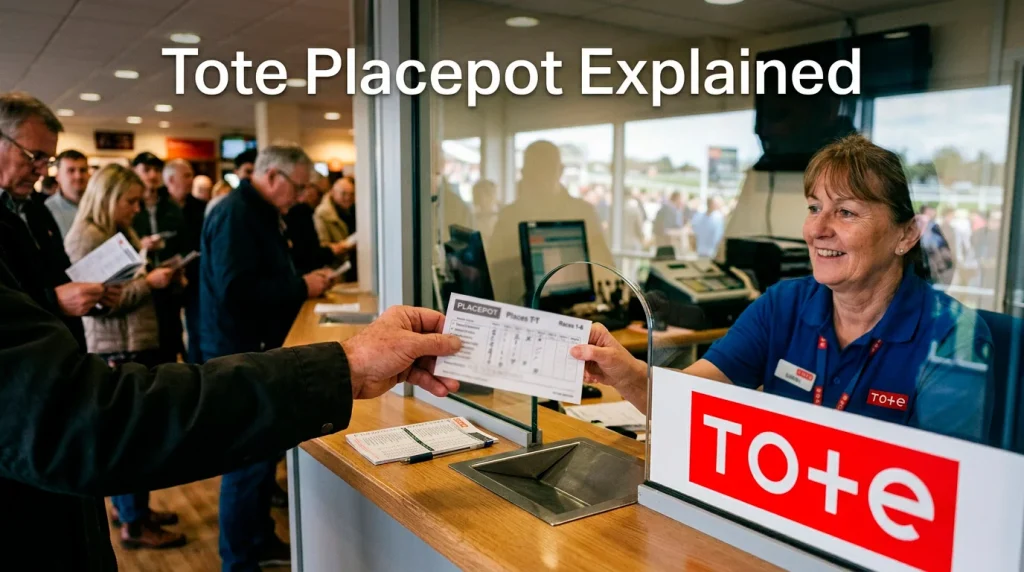
The Tote Placepot is one of the most popular pool bets in British racing and one of the least understood. Six races, one pool, and every leg needs a place — that is the format in a sentence. You select at least one horse to place in each of the first six races on a card. If all six selections place, you share the pool dividend. If any single leg fails, the bet is dead.
The minimum unit stake is £1, which makes the Placepot accessible in a way that stacking six individual each-way bets is not. A £1 Placepot can return hundreds or even thousands of pounds when the results fall awkwardly and the pool is shared among few surviving tickets. On a quiet Tuesday at a Core meeting, a £1 Placepot might pay £30. At a major festival with unexpected results, dividends regularly exceed £1,000. The volatility is the appeal — and the reason you need to understand how the bet works before you start assembling your lines.
The Rules
A Placepot covers the first six races at a designated meeting. You must pick at least one horse to finish in the places in each of those six races. The place terms follow the Tote’s own definitions, which closely mirror the standard Tattersalls terms: two places for five-to-seven runners, three places for eight-to-fifteen runners in non-handicaps, and four places for sixteen-plus handicaps.
You can select more than one horse per leg to increase your chances, but each additional selection multiplies the cost. A single selection in each leg costs £1 (one combination). Two selections in one leg and one in the other five costs £2 (two combinations). Two selections in each of two legs and one in the other four costs £4. The permutations scale quickly — three selections in all six legs would cost £729.
The bet settles after the sixth race. The total pool — all Placepot stakes from all bettors at that meeting — is distributed among holders of winning units, minus the Tote’s takeout. If nobody picks all six placed horses, the pool typically rolls over or is divided among tickets with the most successful legs, depending on the Tote’s rules for that meeting.
How the Dividend Is Calculated
After each leg, the Tote eliminates all units that backed a horse that did not place. The surviving units carry forward to the next leg. After all six legs, the remaining units share the pool. If 100,000 units were sold and only 50 survive all six legs, the dividend per unit is the net pool divided by 50.
This is why Placepot dividends spike when a favourite gets beaten. A short-priced favourite that fails to place in one of the six legs wipes out a huge proportion of tickets that included it. The fewer surviving units, the larger each winner’s share. A single upset in leg three or four can turn a modest pool into a headline-grabbing payout.
Britbet, which operates on-course Tote pools across UK racecourses, handles Placepot pools as part of its broader on-course operation. Total on-course Tote turnover through Britbet exceeded £73.6 million in 2026, with Placepot pools contributing a significant share at major meetings. At the 2026 Cheltenham Festival, Britbet recorded a record on-course turnover of £11.34 million — a figure driven partly by the enormous Placepot pools that the Festival generates.
Building a Placepot
The strategic challenge is balancing coverage with cost. Using a single selection in every leg keeps the cost at £1 but requires six consecutive correct picks — a demanding task. Using two or three selections per leg increases the hit rate but multiplies the outlay.
The standard approach is the banker-and-cover model. Identify one or two legs where you have a strong opinion and use a single selection — your banker. In the remaining legs, use two or three selections to cover the uncertainty. A Placepot with one banker, three legs with two selections, and two legs with three selections costs 1 times 2 times 2 times 2 times 3 times 3 = 72 units, or £72 at £1 per unit. That is still a fraction of what six individual each-way bets at £10 per race would cost (£120), and the upside can be substantially larger.
The key insight: Placepot strategy is about survival, not precision. You do not need the winner — you need a placed horse. Form horses with consistent place records are more valuable than brilliantly talented animals with erratic finishing positions. A horse that finishes second or third in six out of ten starts is a better Placepot selection than a horse that wins three times and finishes unplaced in the other seven.
Placepot vs Each-Way Betting
The Placepot and each-way betting serve different purposes. An each-way bet gives you a fixed-odds payout on a specific horse in a specific race. The Placepot gives you a share of a pool that depends on how many other bettors survived all six legs. The each-way return is predictable; the Placepot dividend is not.
Where the Placepot offers an edge is on days with volatile fields. If multiple favourites lose, the Placepot pool concentrates into fewer surviving tickets, producing outsized dividends. An each-way bet on those same races would have lost if you backed the favourites. The Placepot punishes favourite-backers and rewards those who spread their cover across the card.
Royal Ascot and the Cheltenham Festival produce some of the largest Placepot pools of the year. Lord Herbert of South Downs, of the All-Party Parliamentary Group on Racing and Bloodstock, has noted that events like Royal Ascot remind the country of the world-class quality of British racing — a quality that attracts the kind of attendance and betting volume that makes Placepot pools deep enough for substantial dividends.
Practical Tips
Study the card before committing to your permutations. Identify which legs look the most open — those are the races where you need extra cover. The more competitive the field, the higher the chance that a short-priced horse fails to place and eliminates a chunk of the pool.
Resist the temptation to cover every possible outcome. A Placepot with four selections in every leg costs £4,096 — at that point, the payout needs to exceed the outlay, and you are effectively betting against yourself. The discipline is in choosing where to be bold and where to be cautious, and accepting that a single failed leg can end the bet.
Consider targeting meetings where at least one race features a small field with a strong favourite — that is your banker leg, costing only one selection and requiring minimal cover. Save the additional selections for the races where the field is large and the outcome is genuinely open. A well-constructed Placepot with a mix of bankers and covered legs can keep the cost under £20 while maintaining a realistic shot at a three-figure dividend. That is the nature of the product: six races, one pool, and the mathematics of survival.
Tote Placepot Explained — More on this topic at show bet payout.
See also World Pool Betting.
