
UK Gambling Commission: How Horse Racing Betting Is Regulated
 Available in US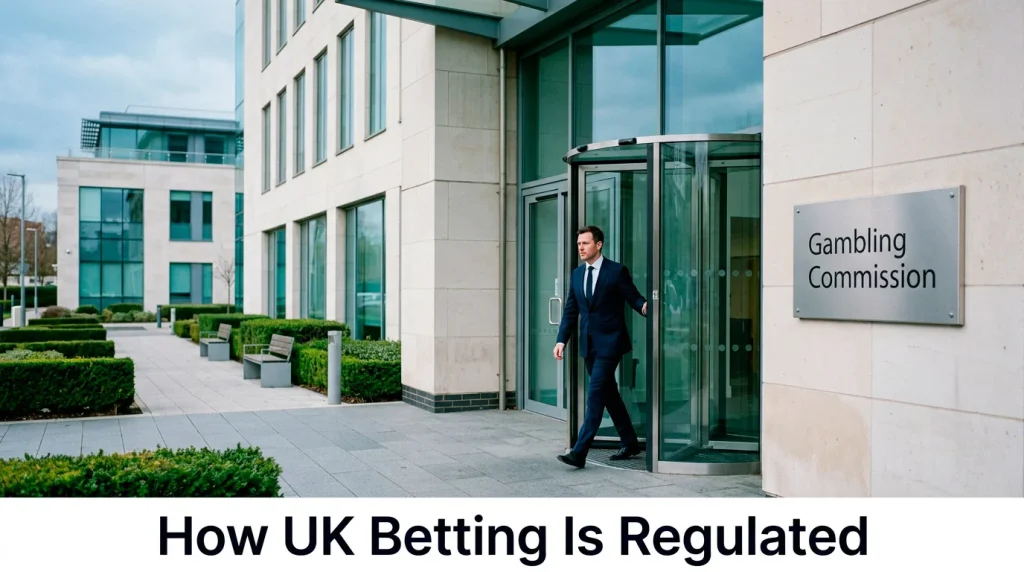
The UK Gambling Commission is the regulator behind every licensed bet you place on horse racing in Britain. Every bookmaker that accepts your each-way wager — online, on the high street, or on course — holds a licence issued by the UKGC and is bound by conditions that cover everything from the clarity of place terms to how complaints are handled. The Commission does not set the odds or decide how many places are paid; those are industry rules under Tattersalls. What it does is ensure that operators behave fairly, transparently, and within the law.
For the punter, the UKGC’s existence is the reason your bet is enforceable, your funds are protected (to a point), and your complaints have a formal route to resolution. Understanding what the Commission does — and what it does not do — gives you a clearer picture of the framework that holds UK horse racing betting together.
The Gambling Act 2005
The legal foundation for UK betting regulation is the Gambling Act 2005, which replaced a patchwork of earlier legislation and created the Gambling Commission as a unified regulator. The Act sets three licensing objectives: keeping gambling crime-free, ensuring gambling is conducted fairly and openly, and protecting children and vulnerable people from harm. Every licensed operator in the UK must pursue all three objectives as a condition of holding their licence.
The Act covers all forms of commercial gambling — casinos, lotteries, betting, and gaming machines — but horse racing betting falls squarely within its scope. Any company that offers fixed-odds bets or pool wagers on British racing must hold the appropriate UKGC licence. Operating without one is a criminal offence.
What the UKGC Does
The Commission’s responsibilities fall into three broad areas: licensing, compliance, and enforcement.
On licensing, the UKGC issues operating licences to bookmakers and personal licences to key individuals within those businesses. The licensing process assesses financial stability, anti-money-laundering controls, responsible gambling measures, and the technical integrity of betting platforms. Once licensed, operators are subject to ongoing conditions published in the Licence Conditions and Codes of Practice — the LCCP.
On compliance, the Commission monitors whether operators meet their licence conditions. This includes regular data reporting, auditing of customer interaction records, and review of marketing practices. The LCCP requires operators to display betting rules clearly, settle bets in accordance with published terms, and provide customers with access to independent dispute resolution.
On enforcement, the UKGC can issue warnings, impose financial penalties, attach additional conditions to licences, or revoke licences entirely. In recent years, the Commission has levied multi-million-pound penalties on operators that failed to identify problem gambling behaviour or breached anti-money-laundering obligations. These enforcement actions are published and serve as both punishment and deterrent.
The Scale of the Market
The UKGC’s 2026-2026 annual statistics reported gross gambling yield of £766.7 million from remote (online) horse racing betting alone. Football led with £1.3 billion, and total remote GGY across all sports and products was £2.6 billion. Horse racing’s share is substantial — the second-largest single sport in the UK betting market — and the Commission’s regulatory footprint covers every pound of it.
The broader gambling participation picture adds context. The Commission’s Gambling Survey for Great Britain, conducted in 2026, found that 48% of adults had participated in some form of gambling in the previous four weeks. Among those, 10.3% had bet on horse racing or sports online — a figure that translates into millions of individuals whose each-way bets, accumulators, and Tote pool wagers are all placed within the UKGC-regulated ecosystem.
How Regulation Protects the Each-Way Bettor
Several LCCP requirements are directly relevant to anyone placing each-way bets on horse racing. Operators must publish their betting rules, including place terms, in a format that customers can access before placing a bet. If a bookmaker advertises enhanced place terms on a race, the specific conditions — number of places, fraction, any caps — must be clearly stated. Ambiguity in terms is a licence-condition issue, not just a customer-service failure.
Settlement disputes have a formal resolution path. If you believe your each-way bet was settled incorrectly — perhaps a Rule 4 deduction was applied when you think it should not have been, or the place terms did not match what was advertised — you can escalate through the operator’s internal complaints process and, if unresolved, to an approved Alternative Dispute Resolution provider such as IBAS (Independent Betting Adjudication Service). The UKGC does not adjudicate individual bets, but it requires that every licensed operator participates in an ADR scheme.
Customer funds protection is another area of Commission oversight. Licensed operators must either hold customer funds in a separate account, insure them, or hold them under a trust arrangement. The level of protection varies — some operators offer higher protection than others — and the UKGC publishes each operator’s protection level on its public register. If an operator were to become insolvent, the level of fund protection would determine how much of your account balance you could recover.
The public register itself is a useful tool that most punters never consult. Available on the UKGC’s website, it lists every licensed operator with their licence status, any regulatory actions taken against them, and their customer-funds protection level. Before opening an account with a new bookmaker, checking the register takes less than a minute and confirms that the operator is licensed, current, and in good standing. An unlicensed operator has no obligation to honour your bets, settle disputes, or protect your funds — and any each-way bet placed with one is, in regulatory terms, unprotected.
What the UKGC Does Not Do
The Commission does not set odds, determine place terms, or mandate specific payout levels. Place terms are governed by the Tattersalls Committee Rules on Betting, a separate industry body. The UKGC’s role is to ensure that whatever terms are offered are communicated clearly and applied consistently — not to dictate what those terms should be.
The Commission also does not guarantee that you will win, that odds are fair in a mathematical sense, or that the bookmaker’s margin is reasonable. Overround, for example, is a commercial decision by the operator, not a regulatory matter. The UKGC’s mandate is fairness and transparency, not the elimination of the house edge.
Understanding this boundary is useful. When a settled bet looks wrong, the question is whether the operator applied its own rules correctly — and that is a dispute-resolution question. When the rules themselves seem unfavourable, that is a commercial choice by the operator within a framework that the Commission oversees but does not micromanage. The UKGC is the referee, not the rule-maker for the specifics of each-way settlement.
UK Gambling Commission — More on this topic at show bet payout.
See also Horserace Betting Levy.
