
Across the Board Bet in Horse Racing: Win, Place and Show in One
 Available in US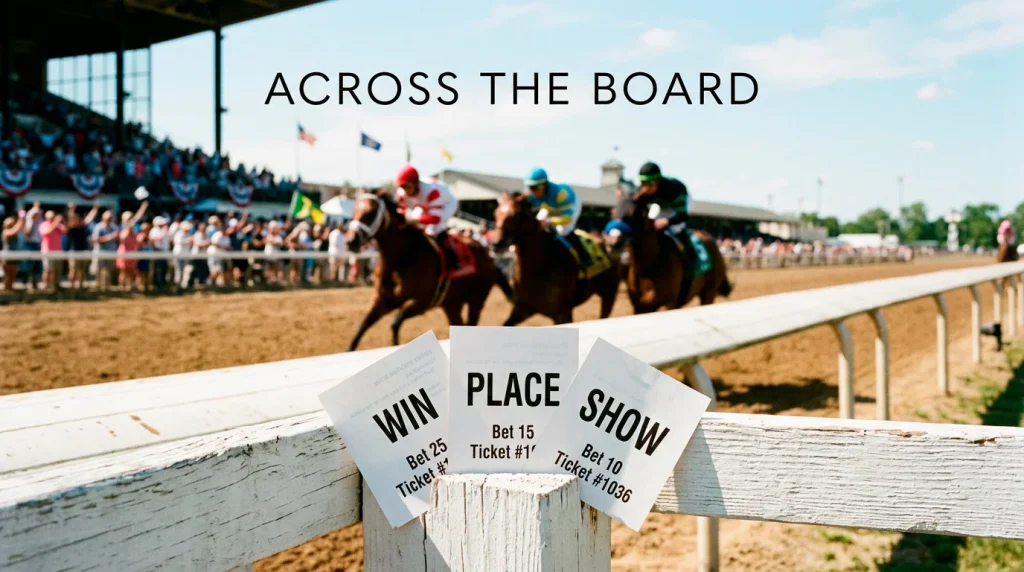
An across the board bet in horse racing is three bets on one horse, settled three different ways. You are placing a win bet, a place bet, and a show bet simultaneously — each as a separate wager into its own pari-mutuel pool. The cost is three times your base stake. If you bet $2 across the board, you are spending $6: $2 to win, $2 to place, and $2 to show.
The appeal is obvious: maximum coverage. If your horse wins, all three bets pay. If it finishes second, the place and show legs collect while the win leg dies. Third, only the show bet survives. Fourth or worse, everything loses. Each leg is settled independently through its own pool, which means the payouts for win, place, and show can vary dramatically depending on how the betting public distributed its money.
In the UK, there is no direct equivalent. British racing’s primary multi-outcome wager is the each-way bet — two bets rather than three, covering win and place at fixed odds. The structure, the cost, and the settlement all differ. But for anyone encountering the term on a US racing card or through an international simulcast, understanding across the board is straightforward once you see how the three legs operate.
How the Three Legs Work
An across the board bet feeds into three separate pari-mutuel pools. On US racetracks, each pool operates independently:
The win pool collects all money wagered on horses to finish first. After takeout, the net pool is divided among holders of tickets on the winning horse. The place pool collects all money wagered on horses to finish first or second. After takeout, the net pool splits between holders of the top-two finishers. The show pool collects all money wagered on horses to finish in the top three. After takeout, the net pool splits three ways.
Each pool calculates its own dividend. Your across the board ticket is really three tickets stapled together, and the track settles each one as if it were a standalone wager. This is why an across the board bet can return a profit even when one or two legs lose — the surviving legs pay out from their own pools.
The Four Scenarios
There are only four possible outcomes for an across the board bet, and they are worth spelling out because each triggers a different combination of payouts.
Horse wins. All three legs collect. You receive a win dividend, a place dividend, and a show dividend. This is the maximum return and the reason across the board bets appeal to punters who fancy a horse strongly but want the insurance of place and show if things go sideways at the finish.
Horse finishes second. The win leg is lost. The place and show legs both pay. Your total return is the place dividend plus the show dividend, minus the total $6 outlay (on a $2 base). Depending on the pool composition, this can still produce a healthy profit, particularly on a mid-price horse.
Horse finishes third. Only the show leg survives. You collect the show dividend, but you have lost the win and place stakes. Whether you end up in profit depends on how large the show payout is relative to the $6 investment. On a short-priced favourite, the show return alone rarely covers the full across the board cost.
Horse finishes fourth or worse. All three legs lose. The $6 is gone.
A Worked Example: $2 Across the Board on an 8/1 Shot
Suppose you bet $2 across the board on a horse quoted at 8/1 morning line in a twelve-runner race. Total cost: $6. The horse wins. Here is what might come back, using hypothetical pool dividends:
| Leg | $2 Payout |
|---|---|
| Win | $18.40 |
| Place | $7.60 |
| Show | $4.80 |
Total return: $30.80 on a $6 outlay — a net profit of $24.80. If the same horse had finished second, the return would be $7.60 plus $4.80 = $12.40, still a profit of $6.40 against the $6 stake. If it finished third, you collect $4.80 against a $6 cost — a loss of $1.20, despite the horse making the top three.
That last scenario is the trap of across the board betting on favourites. When a heavily backed horse finishes third, the show dividend is often small because so many tickets share the pool. The show payout alone may not cover the combined cost of three bets. This is why across the board bets work best on mid-range or longer-priced runners, where pool dynamics produce larger dividends on each surviving leg.
Across the Board vs UK Each-Way
The comparison is inevitable, so here are the key differences. An each-way bet in the UK is two bets: win and place. An across the board bet in the US is three: win, place, and show. The cost ratio is 2:1 versus 3:1 against the base stake.
Settlement is the deeper divergence. The UK each-way bet is settled at fixed odds. If you take 8/1 each-way in a race paying three places at one-fifth odds, the place return is always Stake times (8 times 0.2) plus Stake — a calculable figure before the race. The across the board bet is settled through three separate pools, each of which fluctuates until betting closes. The UK punter knows the potential return in advance; the US punter knows only the probability range.
Each-way betting dominates UK racing in a way that across the board betting never has in America. Approximately 74-75% of all bets placed on the Grand National are each-way, making it far and away the most popular format for big-race wagering. The Grand National itself generates an estimated £200 million or more in betting turnover — a single race that moves more money than many US tracks see in a season. That volume is driven almost entirely by the two-legged each-way structure rather than the three-legged across the board format.
Another structural difference: UK place terms shift with the field. A small race might pay only two positions; a big handicap with sixteen or more runners pays four. Across the board in the US always settles against the same three positions regardless of how many horses line up. The American system holds the frame constant — the British system reshapes it race by race.
When Across the Board Makes Sense
The three-leg structure suits a specific profile: a punter who has strong conviction on a horse but wants downside protection across all finishing positions. It is particularly effective when you identify a horse whose show pool is likely to be thin — an overlooked runner in a field where public money concentrates on two or three obvious contenders. In that scenario, the show dividend can be disproportionately generous, and the place dividend adds a further layer of return if the horse finishes in the top two.
It makes less sense on odds-on favourites, where the win pool is so bloated that the win dividend barely covers the triple-stake outlay, and where the show return on a third-place finish almost certainly loses money against the $6 cost. It also makes less sense if you are a UK bettor looking for a direct substitute — each-way at fixed odds gives you certainty that across the board, by design, cannot.
For those navigating both markets, the practical lesson is simple: count the legs, know the settlement mechanism, and run the numbers before you decide which format fits the race and the horse in front of you.
Across the Board Bet in Horse Racing — More on this topic at show bet payout.
See also Each-Way Accumulator Payouts.
