
Enhanced Place Terms & Each-Way Promotions: What Bookmakers Really Offer
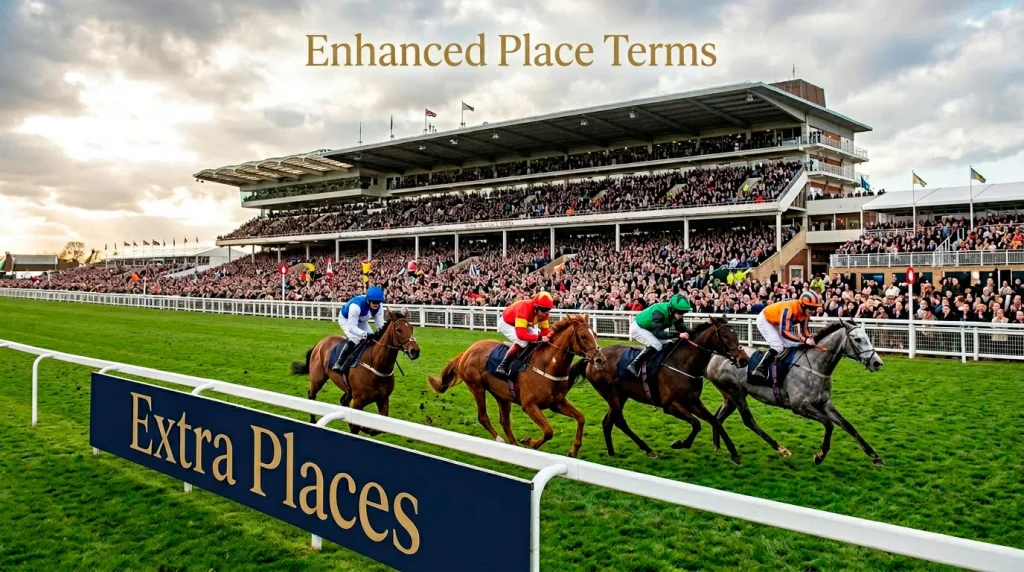
Every major bookmaker in Britain offers enhanced place terms on big races, and the marketing around them is relentless. “Extra places on the Grand National.” “Seven places paid on the Gold Cup.” “Bet365 Each Way Extra — up to 10 places.” The enhanced place terms bookmakers advertise are designed to attract each-way volume, and they succeed: the Grand National alone generates over £200 million in turnover, with each-way bets accounting for roughly three-quarters of all wagers. But the question that the promotions rarely answer is whether the enhancement represents genuine value or simply a louder way of saying the same thing.
Standard place terms under the Tattersalls Rules are a known quantity: two places for five to seven runners, three for eight or more in non-handicaps, four for sixteen-plus handicaps. Enhanced terms sit above this baseline, adding extra paying positions — but often adjusting the place fraction or attaching conditions that reduce the apparent generosity. The difference between a good enhanced offer and a dressed-up standard one is not always obvious at a glance, and working it out requires a bit more maths than most promotional banners suggest.
This guide breaks down what the major bookmakers actually offer, compares the terms across the biggest events on the calendar, and provides a framework for evaluating whether an enhancement is worth routing your bet through — or whether the standard terms, taken at the right price, serve you better.
Standard vs Enhanced: What the Extra Places Actually Mean
Standard place terms are the floor. They are set by the Tattersalls Rules and applied uniformly by every licensed bookmaker in Britain unless a specific promotion overrides them. In a sixteen-plus runner handicap, the standard is four places at one-quarter of the win odds. In a non-handicap with eight or more runners, three places at one-fifth. These terms exist to give each-way bettors a defined settlement structure regardless of which bookmaker they use.
Enhanced place terms add paying positions above this floor. A bookmaker might pay five places instead of four on a big-field handicap, or six, or seven. Some promotions extend as far as ten places on the Grand National or Cheltenham handicaps. The enhancement is genuinely additional: you are being paid on finishing positions that would produce a losing bet under standard terms.
The catch — and there usually is one — comes in two forms. First, the place fraction may change. A bookmaker paying seven places on the Grand National might reduce the fraction from one-quarter to one-fifth, which lowers the place odds on every position including the ones you would have been paid under standard terms. The extra places are real, but the payout per place is smaller. Second, enhanced terms are often restricted to specific race conditions: selected races, minimum odds, maximum stakes, or new-customer-only eligibility. The headline figure of “10 places paid” may apply only if you opt in through a specific product like bet365’s Each Way Extra, which allows punters to trade between the number of places and the place fraction.
Each-way bets account for approximately 74 to 75 per cent of all wagers on the Grand National, according to GrandNational.org.uk. Standard industry place terms for the race — a handicap with typically 40 runners — are four places at one-quarter. Bookmakers push well beyond this baseline because the volume of each-way money at stake makes even small shifts in terms a significant lever for customer acquisition. The punter’s job is to determine whether the shift benefits them or the bookmaker.
Bookmaker Offers Breakdown: Who Pays What
The enhanced place landscape across major UK bookmakers is not static — offers change by race, by season and by competitive pressure — but the structural approaches each firm takes are consistent enough to map. What follows is a factual comparison of how the biggest operators handle enhanced places, Best Odds Guaranteed and each-way flexibility. No rankings, no recommendations — just the terms as they stand.
Bet365 operates Each Way Extra, a product that lets the punter choose how many places are paid and at what fraction. The trade-off is explicit: more places means a smaller fraction, fewer places means a larger fraction. On the Grand National, this can extend to eight or ten places, but the fraction at the far end may drop to one-eighth or lower. The flexibility is genuine — it puts the maths in the punter’s hands rather than offering a fixed take-it-or-leave-it enhancement. Bet365 also offers Best Odds Guaranteed on UK and Irish racing.
William Hill typically offers enhanced places on selected feature races — four to six places on major handicaps, with the fraction usually held at one-quarter or one-fifth depending on the race. Their enhanced terms tend to appear on specific races flagged on the site rather than as an always-available product. BOG is available on UK and Irish races at standard terms.
Ladbrokes and Coral, both part of the Entain group, run similar enhanced place promotions on feature races — often matching each other on the number of places paid. Grand National and Cheltenham Festival races regularly carry five to seven places through these operators. BOG is offered on UK and Irish racing. The terms are typically displayed on the race card page and require no opt-in beyond placing the bet at the advertised conditions.
Paddy Power tends to be aggressive on enhanced places at major festivals, occasionally pushing to seven or eight places on Cheltenham handicaps. Their approach to BOG and each-way terms follows the industry standard. Paddy Power also periodically runs “money back” promotions — returning stakes as free bets if a horse finishes in a specified position just outside the paid places — which functions as a de facto place extension without formally changing the terms.
Betfair Sportsbook offers enhanced places on selected races and operates BOG. As a separate product from the Betfair Exchange, the Sportsbook’s enhanced terms follow conventional bookmaker mechanics. The Exchange itself does not offer each-way betting in the traditional sense — it has separate win and place markets with independently set prices.
Sky Bet and BoyleSports round out the major operators. Sky Bet runs enhanced places on feature races and offers BOG. BoyleSports, a significant player in the Irish and UK markets, treats the Grand National as a centrepiece of its each-way offering. Sharon McHugh, Head of Communications at BoyleSports, has described the race as “an integral part of the trading year and traditionally the race that generates the highest turnover” — Sharon McHugh, BoyleSports, via SBC News.
The common thread across all operators is that enhanced place terms are concentrated on the same races: the Grand National, Cheltenham Festival, Royal Ascot, the Ebor at York, and a handful of other big-field handicaps throughout the season. Midweek racing at Core fixtures rarely attracts enhanced terms because the fields are smaller, the each-way volume is lower, and the commercial incentive to compete on places is weaker.
The Grand National: Enhanced Places at Their Most Extreme
The Grand National is the single biggest showcase for enhanced place terms in British racing. With a field of up to 40 runners, standard Tattersalls terms pay four places at one-quarter of the win odds. But no major bookmaker stops at four. The race generates an estimated £200 million or more in betting turnover on the race itself, with the full Aintree Festival programme pushing the figure past £250 million. Roughly £10 million of that is estimated to flow through unlicensed channels, according to UKBookmakers.org.uk.
Enhanced offers on the National typically range from five to seven places across most bookmakers, with bet365’s Each Way Extra allowing punters to push as far as eight or ten places by accepting a reduced place fraction. At seven places with a one-quarter fraction, a 20/1 shot finishing seventh would return: place odds = 20/1 x 1/4 = 5/1; on a £5 place stake, that is £25 + £5 = £30. At ten places with a one-eighth fraction, the same horse in tenth returns: place odds = 20/1 x 1/8 = 5/2; return = £12.50 + £5 = £17.50. More places, but a meaningfully smaller payout per place.
The question is whether the extra coverage compensates for the reduced fraction. In a 40-runner field, the probability of a randomly selected horse finishing in the top four is roughly 10 per cent. Extending to seven places raises that to about 17.5 per cent. Extending to ten raises it to 25 per cent. The additional probability is real, but it has to be weighed against the lower payout per qualifying position. If you are backing a horse at long odds — 33/1, 50/1 — the extra places can make the difference between a losing bet and a meaningful return, because even a fraction of large odds produces a worthwhile dividend. At shorter prices — 8/1, 10/1 — the reduced fraction may leave the enhanced terms barely covering the stake.
The Grand National also illustrates the scale gap between enhanced-place races and the rest of the calendar. Data from Entain (Ladbrokes and Coral) shows that the Grand National attracted 700 per cent more bets than the Cheltenham Gold Cup in 2026, according to SBC News. That disparity in volume explains why bookmakers compete so aggressively on enhanced terms for this specific race — the customer acquisition value of a generous National offer far exceeds the margin cost of paying a few extra places on a race where the vast majority of each-way bets lose both parts anyway.
For the punter, the Grand National is a rare occasion where enhanced terms deserve serious evaluation rather than automatic acceptance. The field size, the variety of odds available, and the number of competing bookmaker offers create an environment where shopping for the best combination of places and fractions can shift the expected value of the bet by several percentage points. On most other races, enhanced terms are a nice-to-have. On the National, they are a variable worth optimising.
Festival Season: Cheltenham, Ascot and the Enhanced Place Calendar
The Grand National is not the only race that attracts enhanced place terms — it is simply the most extreme example. The broader festival calendar produces a concentrated season of enhanced offers that runs from mid-March through late July, with secondary peaks around the major autumn and winter meetings.
Cheltenham Festival sits at the heart of this calendar. William Hill projected approximately £450 million in total wagering across the four days of the 2026 Festival, making it the most heavily bet racing event of the year by aggregate volume, according to William Hill. Every race on the Cheltenham card is competitive enough to attract enhanced terms from multiple bookmakers. The handicaps — the Coral Cup, the County Hurdle, the Grand Annual — typically feature fields of sixteen or more, triggering four-place standard terms that bookmakers then extend to five, six or seven places as a promotional lever.
What makes Cheltenham distinctive from an enhanced-place perspective is the field size consistency. Average field sizes at the 2026 Festival reached 16.1 runners, which means almost every race on the card sits at or above the sixteen-runner handicap threshold. Even the non-handicap championship races — the Champion Hurdle, the Gold Cup, the Queen Mother Champion Chase — attract large enough fields for three-place standard terms, with bookmakers typically offering a fourth place as an enhancement.
Royal Ascot operates in a slightly different mode. As a primarily Flat meeting with a mix of Group races and big-field handicaps, the enhanced place landscape is more varied. The Royal Hunt Cup and the Wokingham Stakes — large-field handicaps — attract enhanced terms comparable to Cheltenham handicaps. The Group 1 races, which tend to have smaller fields, may receive an extra place but the impact is modest compared to the handicaps. Where Royal Ascot stands out is in the World Pool overlay: with global liquidity from the Hong Kong Jockey Club and partner jurisdictions, pool bettors at Ascot have a genuine alternative to enhanced fixed-odds terms.
Beyond the big two, Glorious Goodwood, York’s Ebor meeting, Newmarket’s major fixtures and the Scottish Grand National at Ayr all attract enhanced place offers from most major bookmakers. The pattern is consistent: the bigger the field, the higher the profile of the meeting, the more aggressive the enhanced terms. The punter who maps the enhanced-place calendar in advance — knowing which meetings and which races carry the best terms — can concentrate each-way activity during the periods when the structural terms are most favourable.
Outside festival season, enhanced places are sparse. Midweek all-weather fixtures and low-profile jumps cards rarely attract anything beyond standard Tattersalls terms. The commercial incentive is not there: fields are smaller, turnover is lower, and the cost of paying extra places is not offset by sufficient customer acquisition value. Each-way punters who bet year-round should recognise that the enhanced-place offers they see during festival season are the exception, not the rule, and adjust their expectations — and strategies — accordingly.
Evaluating the Edge: Is the Enhancement Worth Taking?
Enhanced place terms are only valuable if the additional places carry enough probability and payout to improve the expected value of the bet. Accepting ten places at one-eighth on the Grand National sounds generous — until you calculate that the place odds on a 10/1 shot at one-eighth are 10/8, barely above evens, and the horse needs to finish in the top ten of a 40-runner field. The question is whether the mathematics favour the punter or the bookmaker.
A simple framework for evaluating enhanced terms involves three steps. First, estimate the probability that your horse finishes in the enhanced place range — that is, in the positions added by the enhancement but not covered by standard terms. If standard terms pay four places and the enhancement pays seven, you need the probability of finishing fifth, sixth or seventh. In a 40-runner race with relatively open form, a crude estimate is that each position carries a probability of roughly 1/40 or 2.5 per cent (assuming uniform distribution, which is a simplification). Three additional positions give approximately 7.5 per cent extra coverage.
Second, calculate what the enhanced place pays in that range. At one-quarter of 20/1, finishing seventh pays place odds of 5/1 — a £30 return on a £5 stake. At one-eighth of 20/1, it pays 5/2 — a £17.50 return. The payout difference is significant and depends entirely on whether the fraction has been reduced as part of the enhancement.
Third, compare the expected value. Under standard terms (four places, one-quarter), the expected return from the place leg depends on the probability of finishing in the top four multiplied by the standard place payout. Under enhanced terms, add the probability of finishing fifth through seventh (or whatever the extended range is) multiplied by the enhanced place payout. If the enhanced expected value exceeds the standard expected value, the enhancement is worth taking. If the fraction reduction has compressed the payout enough to offset the extra positions, it is not.
In practice, enhanced terms tend to be most valuable on long-odds horses in big fields. A 33/1 shot at one-quarter enhanced to seven places gives place odds of 33/4 — over 8/1 — on positions five through seven. The probability of hitting those positions is low, but the payout when you do is substantial. For a 4/1 shot, the same enhancement gives place odds of 1/1 on the extended positions — a marginal return that barely justifies the reduced fraction on the standard positions you were already being paid on.
The most disciplined approach is to calculate the break-even point: at what odds does the enhanced term become more valuable than the standard term? The answer depends on the specific fraction reduction and the number of additional places, but as a rough guide, enhanced terms tend to favour the punter when the win odds are 12/1 or longer in a field of twenty or more. Below that threshold, the fraction reduction often costs more on the standard positions than the extra positions add in expected value.
One final consideration: enhanced terms are promotional. They are not permanent features of the market, and they are not offered because bookmakers believe they lose money on them. The bookmaker has calculated that the volume of losing bets attracted by the enhanced offer more than compensates for the additional payouts on the extra places. The punter who treats enhanced terms as a default rather than a decision — blindly accepting whatever the bookmaker offers without running the numbers — is playing the role the promotion was designed for. The punter who evaluates each enhancement against the standard terms, race by race and horse by horse, is the one most likely to extract genuine value from the offer.
In practice, the evaluation does not need to be laborious. Before placing an each-way bet on a race with enhanced terms, ask two questions. First: are my horse’s win odds long enough for the reduced fraction (if any) to still produce place odds above evens? If the answer is yes, the enhancement is working for you. If the answer is no — if the place odds on the standard positions have been compressed below evens — then the extra places may be costing you more on the positions you were already likely to collect on than they add on the extended positions you are unlikely to reach.
Second: does my horse have a realistic chance of finishing in the enhanced range? Backing a horse with strong form at 20/1 each way with seven places paid on the Grand National is a considered bet. Backing the same horse with ten places paid at a one-tenth fraction because the number ten sounds better than seven is not strategy — it is the bookmaker’s marketing working exactly as intended. Extra places, extra edge — or extra marketing? The answer depends on whether you run the numbers before you bet.