
Tote Pool vs Fixed-Odds Bookmaker: How UK Place Payouts Differ
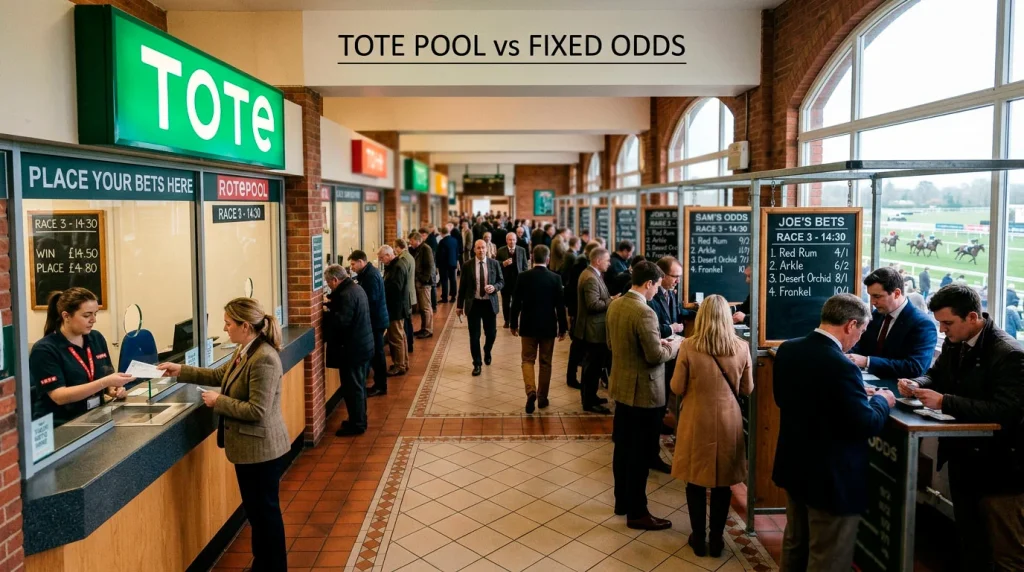
Every punter placing a Tote place bet payout slip at a British racecourse or tapping into the Tote app is making a fundamentally different bet from the one placed with a fixed-odds bookmaker on the same horse in the same race. The distinction is not cosmetic. It is structural. With a bookmaker, your place odds are locked in the moment you confirm the slip — you know exactly what you will receive if the horse finishes in the places. With the Tote, your payout is a dividend calculated after the race, determined by how much money went into the pool and how it was distributed across the field.
The practical difference shows up in the numbers. At Royal Ascot 2026, the World Pool Win dividend beat the Starting Price in the majority of races run across the five-day meeting. That is not a marginal edge — it means pool bettors received more than those who settled at SP with their bookmaker in most races on the card. The reverse also happens: in smaller races with thin pools, the Tote dividend can fall short of what a fixed-odds bet would have returned.
Understanding when each system works in the punter’s favour requires a closer look at the mechanics behind both. How does money flow through a Tote pool? How does a bookmaker price the place market? What role does liquidity play? And when the World Pool connects British racing to a global betting audience, what does that mean for the dividend landing in your account? The pool where every punter sets the price operates on different logic from the shop where the bookmaker sets it for you. Knowing which to use, and when, is a genuine edge.
How the Tote Pool Works
The Tote — formally the UK Tote Group — operates Britain’s pool betting system on horse racing. The principle is straightforward: all bets of a given type on a given race go into a single pool. The operator takes a percentage commission, known as the takeout, and the remainder is divided among the winning ticket holders in proportion to their stakes. No bookmaker is setting odds. No margin is baked into a price at the point of sale. The payout is a function of collective behaviour: how much was bet, and on which horses.
For place pools specifically, the process works like this. Every Tote place bet on a race enters the place pool. After the race, the takeout is deducted — typically around 24 to 26 per cent on UK place pools, though the exact rate varies by pool type. The remaining money is then divided among all tickets that backed horses finishing in the paying places. Each placed horse receives an equal share of the pool (after deducting the stakes on that horse from its share), and the dividend per unit stake is calculated by dividing that share by the total amount staked on that particular horse.
The result is a payout that nobody — not the punter, not the Tote operator, not the most sophisticated algorithm — can know in advance. If a heavily backed favourite finishes in the places, the pool has to be split among a large number of winning tickets, which compresses the dividend. If an unfancied outsider fills one of the place positions, the relatively small number of tickets on that horse means each one receives a larger share of the pool. This dynamic creates the distinctive feature of pool betting: the payout is inversely proportional to the popularity of the selection.
On-course, pool betting in Britain is managed through the Britbet network, a consortium of racecourses that operates Tote windows at tracks across the country. In 2026, on-course Tote turnover through Britbet exceeded £73.6 million, a figure that represents a 26 per cent increase since 2018 when the Britbet partnership was established. That growth reflects both improved on-course facilities and a broader resurgence in raceday attendance.
Off-course, the UK Tote Group runs the tote.co.uk platform and app, which extends pool betting to online punters. The combined UK and Irish Tote pool has grown by 50 per cent during the Tote–Britbet partnership, with the online customer base exceeding 100,000 active users. The Tote Group has invested more than £100 million in the business, modernising the pool product and expanding its digital reach. For punters who grew up with fixed-odds betting and never considered the pools, the platform now offers a credible alternative with a substantially larger liquidity base than the on-course windows alone could provide.
One operational detail that matters: Tote place pools follow the same place terms as bookmaker each-way bets. The number of paying places is determined by the Tattersalls Rules based on field size and race type — two places for five to seven runners, three for eight or more in non-handicaps, four for sixteen-plus handicaps. The pool mechanic does not change the number of places; it only changes how the payout for those places is calculated.
A simplified example illustrates the mechanics. Suppose a place pool on a ten-runner race collects £100,000 in total stakes. The takeout at 25 per cent removes £25,000, leaving £75,000 to be distributed. Three horses qualify for the places. Horse A attracted £20,000 in place stakes, Horse B attracted £8,000, and Horse C attracted £3,000. Each horse’s share of the distributable pool is one-third of £75,000 = £25,000. For Horse A, the dividend per £1 staked is (£25,000 – £20,000) / £20,000 + £1 = £1.25. For Horse C, the unfancied outsider: (£25,000 – £3,000) / £3,000 + £1 = £8.33. The same pool, the same race, but the less popular selection pays more than six times what the favourite pays. That is the pool dynamic in its purest form.
Fixed-Odds Place Betting: Known Returns, Hidden Margins
The fixed-odds system works on opposite logic. When you place an each-way bet with a bookmaker, the place odds are derived from the win odds using a set fraction — one-fifth or one-quarter, depending on the race conditions. Those odds are locked at the moment you confirm the bet (or at SP if you choose not to take a price). The horse finishes in the places, and you receive exactly what the mathematics of the fraction and the win odds promised. No pooling. No post-race calculation. No dependence on what other punters did.
The bookmaker’s profit comes from the overround — the margin built into the odds across the entire field. If you add up the implied probabilities of every horse’s win odds, the total will exceed 100 per cent. The excess is the bookmaker’s edge. For the place market, the overround operates similarly: the place odds derived from the win odds and the standard fraction carry their own embedded margin. The punter rarely sees this margin in isolation because place odds are not independently priced in each-way betting — they are a mechanical derivative of the win odds and the Tattersalls fraction.
This is the key trade-off. Fixed-odds place betting offers certainty: you know your payout before the race starts. But that certainty comes at a cost. The bookmaker has priced the market to guarantee a profit over time, and the overround ensures that the aggregate payouts to punters are less than the total stakes collected. In a competitive market, the overround might be slim — 3 to 5 per cent on a major race. On a quiet midweek card, it can balloon to 15 or 20 per cent. The punter pays for certainty through that margin, whether they realise it or not.
Starting Price introduces a complication. Punters who do not take a fixed price receive the SP, which is determined by the on-course market at the moment the race starts. SP is meant to reflect the true state of the betting market at the off, but it is derived from the prices offered by on-course bookmakers — who are themselves running a book with an overround. The SP is not a “neutral” price; it is a snapshot of a margin-bearing market. For each-way punters, SP settlement applies to both the win and place parts, which means both legs of the bet settle at a price that includes the on-course bookmaker’s margin at that specific moment.
Where fixed odds hold a clear advantage is in transparency and planning. A punter who takes 10/1 each way on a horse in a three-place, one-fifth race knows the exact returns for every possible outcome before the stalls open. Win: £55 return on £5 each way. Place only: £15. Out of the places: zero. That precision allows for stake management, profit targeting and portfolio-style betting in a way that pool dividends — inherently unknowable until after the race — do not.
Tote Dividend vs Starting Price: When the Pool Pays More
The question that every each-way punter should be asking is not which system is better in theory, but which system paid more on the races they actually bet on. The answer varies by race, by meeting, and by the specific horse backed — but the aggregate data from major fixtures provides a useful compass.
The most comprehensive recent dataset comes from Royal Ascot 2026, where the World Pool was in operation across all five days. Total World Pool turnover for the meeting rose 10 per cent year on year to HK$1,574.4 million — approximately £150 million at prevailing exchange rates. Across 35 races, the World Pool Win dividend exceeded the Starting Price in 20 — a 57 per cent overpay rate. For Exacta bets, the pool version beat the fixed-odds Forecast in 23 of 35 races. The place pool data follows a similar pattern, though the overpay margin tends to be narrower on place dividends because the pool is split across multiple qualifying positions.
Several factors drive this outcome. First, liquidity. A pool with £150 million in turnover over five days can absorb large individual bets without dramatically shifting the dividend. When a single punter places a £10,000 win bet into a pool of millions, the effect on the overall dividend is negligible. In a thin pool at a Monday meeting at Plumpton, the same bet could shift the dividend substantially, often to the punter’s disadvantage. Liquidity buffers volatility, and major meetings have liquidity in abundance.
Second, the distribution of money across the field. Tote dividends reward contrarian selections. If you back a horse that attracts relatively little pool money and it finishes in the places, your share of the pool is proportionally larger. In fixed-odds betting, the bookmaker’s price already reflects the horse’s perceived chance — you get the odds you take regardless of what other punters do. But in a pool, backing an overlooked horse at a big meeting can produce a place dividend that significantly exceeds what the fixed-odds place terms would have paid.
Alex Frost, Chief Executive of the UK Tote Group, summarised the appeal after the 2026 Royal Ascot meeting: “Royal Ascot was absolutely exceptional… World Pool perfectly showcases the enduring appeal of British racing’s highest profile flat meeting, particularly with an international audience” — Alex Frost, UK Tote Group, via Sports News Blitz.
The flip side is equally important. When the favourite dominates the pool and finishes in the places, the dividend can fall below SP. A huge proportion of the pool was staked on that horse, so the payout per unit is compressed. In those cases, the fixed-odds punter who locked in 5/4 each way before the off receives a better return than the pool bettor whose dividend comes back at barely over evens. The Tote is not uniformly superior — it rewards specific conditions and punishes others.
As a general heuristic: the Tote tends to overpay on less popular horses at high-liquidity meetings, and underpay on heavily backed favourites. Fixed odds tend to offer better value on shorter-priced horses where the bookmaker’s margin is thinnest, and at smaller meetings where thin pools create erratic dividends. The choice between systems is not a loyalty decision — it is a tactical one, recalibrated race by race.
The World Pool: Global Liquidity Meets British Racing
The World Pool is a commingled betting pool operated by the Hong Kong Jockey Club in partnership with racing jurisdictions around the world. When a UK meeting carries World Pool status — Royal Ascot, selected days at Cheltenham, York’s Ebor Festival and a handful of others — bets placed in Hong Kong, the UK, France, Australia, Japan and other participating territories are all merged into a single pool. The result is a pool of a size that no single domestic market could generate on its own.
For British racing, the significance of the World Pool lies in what liquidity does to dividends. A domestic Tote pool on a Tuesday at Kempton might total a few hundred thousand pounds. The World Pool on an Ascot Gold Cup day can run into tens of millions. That difference in scale smooths out the volatility that plagues small pools. In a thin pool, a handful of large bets on one horse can dramatically distort the dividend. In a World Pool, the sheer mass of money makes individual bets statistically irrelevant to the overall payout structure.
The Cheltenham Festival 2026 illustrates the point. Britbet recorded a record on-course Tote turnover of £11.34 million across the four days, an increase of roughly £600,000 from 2026. That figure covers only the on-course windows; when World Pool and off-course online activity are added, the total pool for Festival races was substantially larger. The increased field sizes at the 2026 Festival — averaging 16.1 runners, up from 13.6 the year before — contributed to larger, more liquid pools, which in turn produced more stable and often more generous dividends.
Not every UK meeting qualifies for the World Pool. The selection of fixtures is curated: only meetings with international profile and sufficient field sizes are included. This means the World Pool advantage is concentrated at the top end of the calendar. For the punter, the practical implication is clear: if a race carries World Pool status, the Tote place dividend is backed by global liquidity and is more likely to be competitive with — or better than — the fixed-odds place return. If the meeting does not carry World Pool status, the domestic pool may be thin enough that fixed odds offer a more reliable payout.
The World Pool also introduces a subtlety around currency and timing. Bets placed in different jurisdictions are denominated in different currencies and placed at different times of day. Hong Kong punters are betting in the early hours of British mornings, and their money enters the pool before UK punters have even checked the declarations. The pool’s composition shifts throughout the day as different markets wake up and participate. Final dividends reflect this global aggregation, which can produce payouts that diverge from what purely domestic betting patterns would suggest — sometimes favourably, sometimes not.
When Pool Beats Fixed — and When It Does Not
Pulling the analysis together, the decision between Tote pool and fixed-odds place betting is not binary. It depends on the meeting, the race, and the horse. But several practical rules emerge from the data and the mechanics.
Pool betting tends to outperform fixed odds on major meetings where the World Pool is active and liquidity is deep. Royal Ascot, the Cheltenham Festival and selected days at York and Newmarket fall into this category. On these cards, the pool dividends are underpinned by global money, and the overpay rate — the proportion of races where the Tote dividend beats SP — has consistently been above 50 per cent in recent years. For a punter who regularly bets at these meetings, routing place bets through the Tote rather than the bookmaker represents a measurable long-term gain, assuming selections are spread across a mix of favourites and longer-priced runners.
Pool betting tends to underperform on small meetings with thin domestic pools. A place pool totalling £30,000 at a midweek all-weather fixture is easily distorted by a few large bets, and the dividend on a placed favourite can come back well below the fixed-odds equivalent. At these meetings, the bookmaker’s fixed price — even with its overround embedded — provides a more reliable floor for the place payout. The certainty premium that the punter pays through the margin is actually worth it when the alternative is an erratic pool dividend.
The type of horse you back also matters. The Tote rewards contrarian bets. If you are backing a 14/1 shot each way and it finishes third, the pool dividend may well exceed the fixed-odds place return because relatively little money was staked on that horse in the pool. Conversely, if you are backing the 2/1 favourite, the bulk of the pool is concentrated on the same horse, compressing the dividend. For favourite backers, fixed odds are almost always the better route. For those who target longer-priced selections — particularly at well-attended meetings — the Tote is structurally more generous.
One number puts the broader economics in perspective. The Horserace Betting Levy — the statutory contribution that bookmakers pay on their gross profits from British racing — amounts to approximately 0.7 per cent of total betting turnover, one of the lowest rates of return from betting to racing anywhere in the world. The Tote operates outside this framework with its own takeout structure, meaning the proportion of stakes returned to punters is governed by the pool’s commission rate rather than the bookmaker’s overround. Neither system is “free” for the punter, but the cost structures are different, and understanding where your money goes is part of choosing where to put it.
The pragmatic approach is to treat the two systems as complementary rather than competing. Use fixed odds when you want price certainty, when you are backing short-priced horses, or when the meeting does not carry World Pool status. Use the Tote when liquidity is deep, when your selection is unfancied, and when the World Pool’s global reach gives the pool the scale needed to produce competitive dividends. The punter who switches between systems based on conditions — rather than habit — has a structural advantage over the punter who only ever uses one.